
Table of Contents
- Why Cluttered Decor Happens and How to Spot It Early
- How to Reduce Visual Clutter Without Stripping the Character
- How to Style Collectibles So They Look Curated, Not Crowded
- Shelf Styling Ideas That Give Every Piece Room to Breathe
- Decluttering Tips for the Home When You Love Vintage Pieces
- Choosing the Right Display Pieces for a Clean Retro Look
- How to Keep Cluttered Decor From Returning Over Time
- Conclusion: Display Less, Enjoy More
- Frequently Asked Questions
Last Updated: October 5, 2026
Why Cluttered Decor Happens and How to Spot It Early
Cluttered decor is what happens when a collection grows faster than the space built to hold it. The fix is not buying less. It is displaying with a plan.
Most clutter creeps in quietly. You spot it too late, once the room already feels heavy.
Watch for these early signs:
- Every flat surface holds at least one object
- You stop noticing individual pieces
- Shelves are packed edge to edge
- New buys go straight into storage
A simple rule helps here. If you cannot name what sits on a shelf from memory, there is too much on it. Style guides from the National Gallery of Victoria's collection care resources make the same point about display: space around an object is part of the object.
How to Reduce Visual Clutter Without Stripping the Character
Reducing visual clutter means cutting the number of items on show, not the personality of the room. Keep the pieces that carry a story. Rotate the rest.
Start with a single shelf or wall. Pull everything off it. Then put back only what you truly love. This one-in-one-out method works because it forces a choice.
Try this sequence:
- Empty one display area completely
- Sort pieces into keep, store, and sell piles
- Return only the keep pile, spaced apart
- Store the rest for a future rotation
Character comes from contrast, not volume. One bold neon sign beside a bare wall lands harder than five signs crammed together.
The One-In-One-Out Rule for Collectors
The one-in-one-out rule is simple: for every new piece you bring home, one existing piece leaves the display. It keeps a collection from growing past what the room can hold.
This rule suits collectors because it respects the hunt. You still buy. You just decide what earns a spot. A vintage lamp from our collection, for example, might replace two smaller pieces that were crowding the same table.

How to Style Collectibles So They Look Curated, Not Crowded
Styling collectibles is about grouping, spacing, and restraint. A curated look comes from how pieces relate to each other, not how many you own.
Curated displays share three traits:
- Clear groups rather than scattered singles
- Empty space between each group
- A repeated colour or material that ties things together
Odd numbers tend to look better than even ones. Three items on a shelf usually read as a set. Four can look like a pile.
Grouping by Theme, Colour, or Era
Grouping by theme, colour, or era gives scattered pieces a shared story. Pick one thread and let it guide the whole display.
- Theme: all motoring memorabilia on one shelf
- Colour: chrome and black across a wall
- Era: mid-century pieces kept together
Mixing threads within one group creates noise. Choose one and commit. Interior styling advice from the Design Institute of Australia backs this approach: a clear focal point makes a room easier to read.
Shelf Styling Ideas That Give Every Piece Room to Breathe
Shelf styling works best when each piece has clear air around it. Aim for roughly one-third empty space on any shelf. That gap is what makes the objects on it feel deliberate.
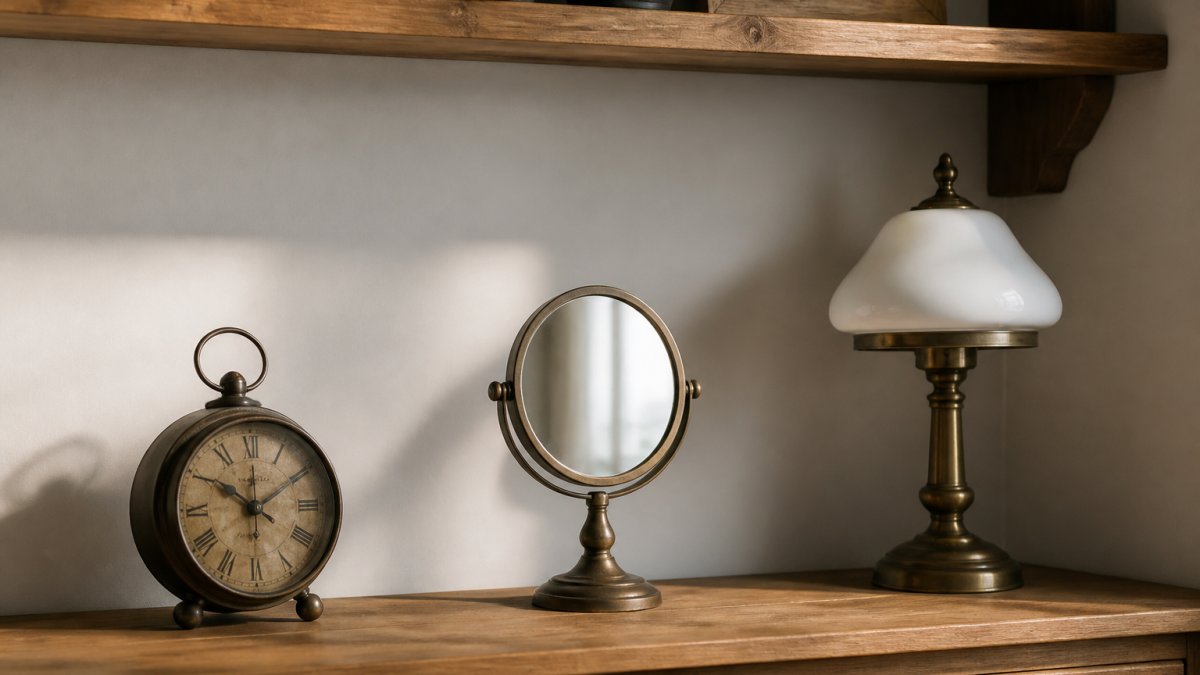
Try these layouts:
- One large piece centred, two small ones flanking it
- Tall items at the ends, short ones in the middle
- A single statement piece alone on a wide shelf
Our Vintage Wall Decor Set of 3 shows how a small, matched group can fill a wall without crowding it. Three pieces, one theme, plenty of wall left bare.

Decluttering Tips for the Home When You Love Vintage Pieces
Decluttering tips for the home work differently when you love vintage pieces. You are not throwing things away. You are deciding what stays on show and what rests.
Here is a rotation system that suits collectors:
| Step | Action | How Often |
|---|---|---|
| 1 | Pick your current display pieces | Every season |
| 2 | Store the rest safely | Ongoing |
| 3 | Swap in stored pieces | Every 3-4 months |
| 4 | Reassess what you still love | Twice a year |
Rotation keeps a room fresh without new spending. It also protects delicate items from constant light and dust. Care guidance from the Australian Institute for the Conservation of Cultural Material notes that limiting light exposure helps preserve older pieces.
Choosing the Right Display Pieces for a Clean Retro Look
Choosing display pieces for a clean retro look comes down to scale and purpose. One well-chosen item beats five average ones.
Ask three questions before you buy:
- Does it have a clear spot to live?
- Does it match a theme I already have?
- Will it crowd what is already there?
A single Vintage Lamp at $150 can anchor a whole corner. A pair of smaller Vintage Lights at $50 each can frame a bar shelf without filling it. The right piece earns its space.
How to Keep Cluttered Decor From Returning Over Time
Keeping cluttered decor from returning takes a habit, not a one-off clean. Set a monthly check and stick to it.
Build these into your routine:
- A 10-minute shelf review each month
- A strict one-in-one-out policy
- A storage box for pieces on rest
- A rule against buying without a plan
Ten minutes beats a full weekend clear-out every time.
Conclusion: Display Less, Enjoy More
The hardest part of collecting is knowing when to stop adding. A crowded room hides the very pieces you love most. At Lost America Cool Classic Collectables, we stock a curated range built for display: Vintage Clocks and Wall Decor, a Vintage Mirror, and statement Vintage Lamps, all chosen to stand on their own. Shop now and give every piece the space it deserves.
Frequently Asked Questions
How can I make a room look less cluttered without removing all its decor?
You don't need to strip the room bare. The trick is to reduce visual noise, not the number of pieces. Group similar items together, leave empty space between displays, and keep flat surfaces like coffee tables and mantels to one or two objects. A vintage lamp priced at $150 or a $50 vintage light can anchor a corner without crowding it. Rotate pieces every few months so the room feels fresh rather than packed.
How many decorative items should you display on a shelf?
A common guideline is three to five items per shelf, depending on shelf length. Odd numbers tend to look more natural than even ones. Leave at least a hand's width of empty space between each piece. If a shelf feels busy, remove one item and see how the remaining pieces breathe. The goal is for each object, like a $75 set of three vintage wall decor pieces, to be noticed rather than lost in a crowd.
How do you balance vintage decor with a tidy, modern-looking room?
Balance comes from contrast. Pair one or two statement vintage pieces with clean, neutral backgrounds. A $90 vintage mirror on a plain wall, or a $100 vintage clock above a simple console, creates focus without clutter. Keep modern surfaces mostly empty and let the vintage items carry the character. Avoid filling every corner; negative space is what makes the retro pieces stand out.
How often should you rotate decorative items on display?
Rotating every three to six months works well for most collectors. It keeps the space feeling intentional and stops items from piling up. Store the pieces you're not displaying in a cupboard or box, and swap them when you want a change. This approach also protects delicate items from dust and fading. You get to enjoy more of your collection without cluttering the room.
Every collector faces the same turning point: the room stops showing off the collection and starts hiding it. Lost America Cool Classic Collectables curates vintage-inspired pieces made to be seen, from wall decor and mirrors to lamps and lights, each one chosen to anchor a space rather than fill it. Shop now and build a display where every piece earns its place.