
Table of Contents
- Why How You Display Classic Collectibles Matters
- How to Arrange Collectibles on Shelves Like a Curator
- Wall Displays: Floating Shelves and Gallery Walls
- Protecting Vintage Collectibles from Dust and UV
- Best Lighting for Display Cabinets and Shelves
- Display Mistakes That Make a Room Look Cluttered
- Final Thoughts on Styling Your Collection
- Frequently Asked Questions
Last Updated: September 4, 2026
Collecting is only half the story. The other half is how you show it off. A rare vintage sign or a pristine classic car model loses its magic when crammed onto a dusty shelf or hidden behind clutter. The best ways to display classic collectibles treat each piece like the artifact it is, balancing visibility with protection.
Displaying classic collectibles well is about creating a focal point that honours the item while keeping your room feeling intentional, not overcrowded. A curated approach transforms a pile of objects into a story. Below, we walk through shelf styling, wall displays, protective cases, and lighting. But first, here is what most guides get wrong: they focus purely on aesthetics and ignore preservation.
Why How You Display Classic Collectibles Matters
How you display classic collectibles directly affects both their visual impact and their long-term condition. A well-planned arrangement lets each piece breathe, creating a space that feels like a personal gallery rather than a storage room.
Preservation should guide your choices from the start. Direct sunlight is the quiet enemy of vintage paper goods, neon signs, and painted metal. Ultraviolet rays cause colours to fade and materials to become brittle over time. Thoughtful display means controlling light exposure, managing dust, and choosing materials that do not react with your items. Collectors who treat their spaces with archival standards tend to keep their pieces in better condition for longer.
How to Arrange Collectibles on Shelves Like a Curator
The most common mistake is lining everything up in a single row like soldiers on parade. Museum curators avoid this because it creates visual monotony. Instead, they build depth and rhythm by grouping pieces in clusters of varying heights. Start by removing everything from your shelves and sorting pieces by theme, era, or colour. Then, build small vignettes rather than filling every millimetre of space.
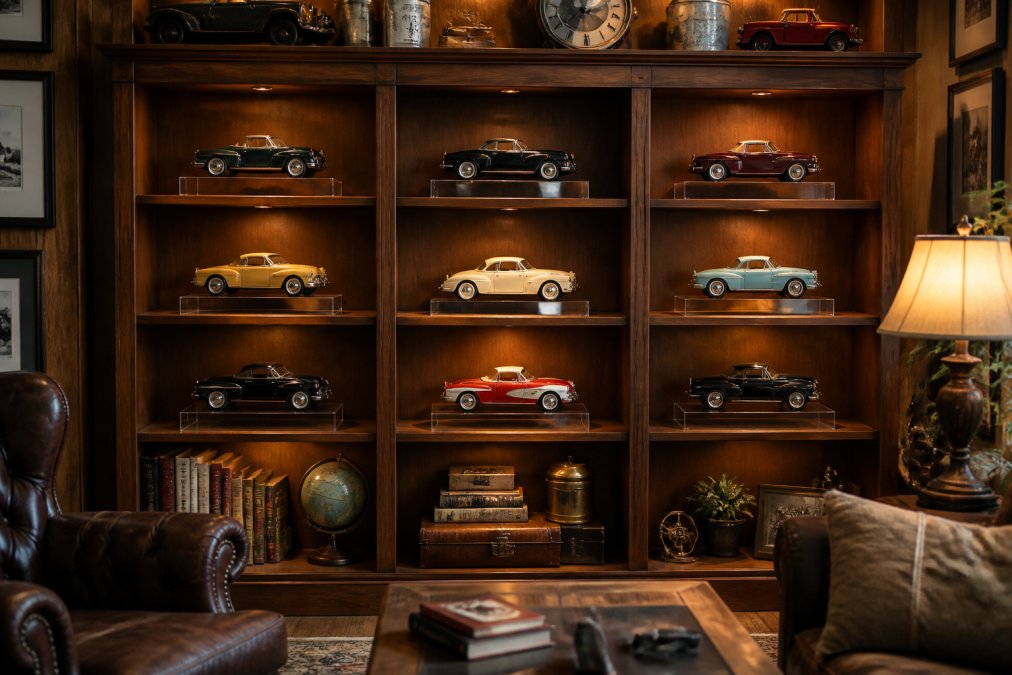
Negative space is your friend. Empty areas between groups give the eye a place to rest and make each item feel more significant. A shelf that is 80 per cent full reads as intentional; one that is 100 per cent full reads as clutter. Step back after arranging and assess the overall silhouette for a pleasing rhythm across the whole unit.
Grouping with Odd Numbers and Triangulation
Grouping items in odd numbers, particularly threes and fives, creates a more natural and pleasing composition than even-numbered pairs. This principle, sometimes called the rule of odds, works because odd groupings feel balanced without feeling stiff. Resist the urge to display two identical cars side by side; instead, pair a larger centrepiece with two smaller supporting pieces.
Triangulation takes this a step further. Visualise an invisible triangle connecting the tops of your three items, with the tallest piece forming the apex and the other two stepping down at the base. This draws the eye upward and gives the arrangement structure. A common approach is to place a large vintage globe or clock at the back, with smaller figurines or model cars angled slightly toward the centre in front.
Using Risers, Pedestals and Vertical Space
Flat shelves waste valuable vertical space. Acrylic risers and small display pedestals add height variation, letting you show more pieces without crowding. Clear acrylic risers, such as those from Better Display Cases, keep the focus on the item itself while creating tiered levels for figurines, cameras, or badges. They are minimalist, durable, and simple to clean, though you should handle them carefully to avoid fine scratches.
Vertical space matters most in smaller rooms. If floor space is limited, think upward. Tall, narrow shelving units make use of wall height and can hold a surprising number of pieces. Pedestals work well for hero items, the one piece you want people to notice the moment they walk in. Reserve the top shelf for your most prized or fragile objects, keeping them out of reach of pets and clumsy hands.
Wall Displays: Floating Shelves and Gallery Walls
Wall displays free up floor space and turn your collection into a room-defining feature. Floating shelves are ideal for larger pieces like vintage globes, cameras, or trophies because the hidden mounting hardware creates a clean, gallery-style look. Custom floating shelves available at Bunnings Warehouse come in various timber finishes and are weight-rated for heavier items.
Gallery walls work best for flat memorabilia such as posters, signs, or framed advertisements. The trick is to plan the layout before hammering a single nail. Lay your frames on the floor and experiment with spacing until the arrangement feels balanced. Keep roughly equal gaps between frames, typically 5 to 8 centimetres, and align the centres at eye level. Mixing frame styles can add character, but keep the colour palette consistent to avoid visual chaos.
Protecting Vintage Collectibles from Dust and UV
Most home styling guides treat dust and sunlight as minor inconveniences. For a serious collector, they are the primary agents of irreversible degradation. Dust is abrasive, composed of fine particles that can scratch delicate surfaces like vintage photographs, lacquered wood, and polished metal every time you wipe them. More insidiously, dust is hygroscopic, absorbing moisture from the air and holding it against the surface of your collectible, creating a micro-environment that accelerates corrosion and mould growth. UV radiation is equally destructive, breaking chemical bonds in dyes, pigments, and polymers, leading to fading and embrittlement that no restoration can reverse.
The Archival Standard: Controlling Light and Humidity
The first step is to measure the problem. A simple UV light meter, available from suppliers like Conservation Resources, can tell you the exact level of UV radiation hitting your display area. The Australian Museum and the National Archives of Australia recommend keeping UV levels below 75 microwatts per lumen for sensitive materials. The most effective solution is to fit UV-filtering film to your windows; 3M's UV films, for example, block up to 99% of UV rays while remaining optically clear. This is more effective and cost-efficient than relying solely on display cases, as it protects the entire room. For humidity, the target range for mixed collections of paper, metal, and textiles is between 45% and 55% relative humidity. In Australia's climate, this often means using a dehumidifier in summer and a humidifier in winter, particularly in coastal or tropical areas. A digital hygrometer, such as those from Jaycar Electronics, is an inexpensive way to monitor conditions. Fluctuations are more damaging than a steady, slightly-off level, so aim for stability.
Choosing the Right Barrier: Glass, Acrylic, and the Microclimate
Enclosing your collectibles is the most effective defence, but the type of enclosure matters more than you might think. Standard float glass blocks some UV but not all. For critical pieces, specify laminated glass or glass with a UV-filtering interlayer, which blocks over 99% of UV radiation. Acrylic, such as Perspex or Optix, naturally blocks a significant portion of UV (typically around 90%), making it a strong choice for frames and cases (peer-reviewed research on UV blocking by acrylic). However, the enclosure itself creates a microclimate. A sealed case can trap moisture if the item was not completely dry when placed inside, so a common professional practice is to include a small silica gel sachet inside the case to buffer humidity. For framed items, the backing board is a critical, often-overlooked component. Standard cardboard is acidic and will off-gas, causing yellowing and brittleness over time. You must use acid-free, archival-grade mounting board and acid-free tape or corners. Suppliers like Archival Survival in Melbourne offer a full range of these materials. This is the difference between storing your items and preserving them.
Handling and Maintenance: The Invisible Threats
Even with perfect barriers, your own hands are a threat. The oils and salts in your skin can permanently stain paper, corrode metal, and leave fingerprints that are difficult to remove (Smithsonian Libraries and Archives blog on handling collections). The professional standard is to wear clean, white cotton or nitrile gloves when handling any valuable piece. If you must handle an item without gloves, hold it by its edges or a non-visible area. When dusting, never use a dry cloth, as this simply grinds the dust into the surface. Instead, use a soft, anti-static brush, like those used for camera lenses, to gently lift dust away. For glass or acrylic surfaces, use a microfibre cloth and a solution specifically designed for acrylic, as standard glass cleaners contain ammonia which can cause acrylic to craze and become cloudy. By adopting these archival practices, you are not just displaying your collection; you are actively protecting your investment for the next generation.
Best Lighting for Display Cabinets and Shelves
Lighting is the difference between a collection that is merely visible and one that is truly showcased. Proper lighting for display cabinets and shelves draws the eye to your pieces and enhances their colours and textures.
Spotlighting works best for hero pieces. A small, adjustable spotlight aimed at a single item creates drama and emphasises detail. For cabinets with multiple shelves, LED strip lights mounted under each shelf provide even, shadow-free illumination. Choose warm white bulbs around 2700K to 3000K for a nostalgic, inviting glow that flatters vintage materials. Cool white light can make pieces look clinical and washed out.
Be mindful of heat. Incandescent bulbs generate warmth that can damage sensitive items over time. LEDs produce very little heat and consume less energy, making them the safer choice for enclosed displays. Always check the manufacturer's recommendations before installing lighting inside a cabinet, and avoid placing lights so close to items that they create hot spots.
Display Mistakes That Make a Room Look Cluttered
A collection should enhance a room, not overwhelm it. The fastest way to make a space look cluttered is to display everything you own without any editing. Resist the urge to show every single piece at once. Rotate your collection seasonally, storing pieces you are not currently displaying in a clean, dry, dark space. This keeps your display fresh and gives each item its moment in the spotlight. However, the most common cause of clutter is not a lack of editing, it is a lack of a scalable display strategy.
The Modular System: A Display That Grows With You
The most effective way to avoid clutter is to invest in a modular display system that is designed to expand. Instead of buying a single, fixed bookcase, consider a wall-mounted rail system, such as those from String Furniture or Vitsoe. These systems consist of a single, slim metal rail that mounts to the wall, onto which you can attach shelves, cabinets, and display bars. You start with one or two shelves and add more as your collection grows. This approach has two major benefits: it keeps your display visually cohesive, as all components share the same design language, and it uses vertical wall space efficiently, which is the single most important strategy for small spaces. For renters, these systems are ideal because they require only a few small holes in the wall, which are easy to patch when you move.
The 80/20 Rule and the 'Hero' Item
Another mistake that leads to a cluttered feel is treating all items as equals. A wall of identical, evenly-spaced objects is visually monotonous and reads as storage, not display. The professional approach is to designate a single 'hero' item per shelf or per wall section. This is the piece that tells the story, the one you want people to notice first. Everything else on that shelf is a supporting player. A practical rule of thumb is the 80/20 rule: 80% of your display should be your curated, themed collection, and 20% should be negative space or a single, bold statement piece. For example, if you collect vintage cameras, do not line up twenty identical models. Choose one rare Leica as your hero, place it on a small acrylic pedestal, and group three or four other cameras around it at varying heights.
Rotating Storage: The Invisible Half of Your Display
Finally, a cluttered room is often the result of a lack of proper storage for the items not on display. If you are rotating your collection, you need a dedicated, clean, and dark storage space. A common mistake is to store off-display items in cardboard boxes in a garage or shed, where they are exposed to temperature extremes, humidity, and pests. The better solution is to invest in archival-quality storage containers. Really Useful Boxes, available at Officeworks, are made of clear polypropylene, which is inert and will not off-gas acids onto your items. For smaller pieces, acid-free tissue paper and compartmentalised containers are essential. This dual approach, a modular, expandable display system for what you show, and an archival storage system for what you do not, is the only way to manage a growing collection without your home turning into a warehouse.
Final Thoughts on Styling Your Collection
Styling a collection is an ongoing process, not a one-time task. As your collection grows, your display should evolve with it. Start with the principles covered here: group in odd numbers, use vertical space, protect against dust and UV, and light with intention. Then refine based on what feels right in your space.
At Lost America Cool Classic Collectables, we understand the pride that comes with owning pieces of the past. Our curated selection of vintage-inspired decor, neon lights, and classic vehicle models is designed to help you build a space with genuine character. Whether you are starting a new collection or reimagining an existing one, we are here to help you find pieces worth showing off.
Frequently Asked Questions
How do you arrange collectibles without making a room look cluttered?
Group items in odd numbers, usually three or five, and vary their heights with risers or pedestals to create visual triangles. Leave empty space around each cluster so the eye can rest. Limit the palette to a few complementary colours and rotate pieces seasonally. This curated approach keeps the display feeling intentional rather than like stored clutter.
What is the best lighting for displaying classic memorabilia?
Use warm LED spotlights or strip lights with a colour temperature around 2700K to 3000K for a nostalgic glow. Position lights at a 30-degree angle to reduce glare and prevent hot spots. Crucially, choose LED fixtures that emit minimal UV and infrared radiation, as these rays cause fading. This protects vintage paper goods and painted surfaces over time.
How can I protect my vintage collectibles from dust and UV while on display?
Enclose items in glass-front cabinets or use acrylic display cases with UV-resistant properties for smaller pieces. For open shelving, establish a regular dusting routine using a soft, anti-static brush. Keep valuable items out of direct sunlight and consider applying UV-filtering film to nearby windows. Archival-quality cases offer the best protection for long-term preservation.
What are the best shelving options for heavy classic items?
For heavy items like vintage globes, radios or die-cast car models, solid timber floating shelves rated for significant weight are a strong choice. Alternatively, modular shelving units with adjustable, reinforced shelves distribute weight evenly. Always check the manufacturer's weight rating and use proper wall anchors suitable for your wall type, especially when displaying items in a garage or den.
Displaying classic collectibles well comes down to balancing visibility with protection. The right arrangement turns a group of objects into a curated story, while proper lighting and dust control keep your pieces looking their best for years. If you are ready to add timeless charm to your home bar, garage, or den, explore the vintage-inspired range at Lost America Cool Classic Collectables and find your next conversation piece. Shop now to see what speaks to you.