
Table of Contents
- Why Classic Memorabilia Still Matters to Car Enthusiasts
- Quick Comparison: Classic Memorabilia Picks and Prices
- Collectible Classic Car Models Worth Displaying
- Vintage Automotive Decor for Home Bars, Garages and Dens
- How to Display Car Memorabilia Without Cluttering Your Space
- Authenticity, Provenance and Sustainability in Memorabilia
- Budget-Tiered Gift Curation for Car Enthusiasts
- Conclusion
- Frequently Asked Questions
Last Updated: September 23, 2026
Why Classic Memorabilia Still Matters to Car Enthusiasts
Classic memorabilia for car enthusiasts is more than decoration, it keeps automotive heritage alive in the spaces where people actually spend their time. At Lost America Cool Classic Collectables, we see it daily: a wall hanging or scale model does more than fill a shelf gap. It starts conversations.
Quick Comparison: Classic Memorabilia Picks and Prices
Every item below comes from our own curated range, so prices are fixed and current.
| Item | Price | Category | Best For |
|---|---|---|---|
| 1948 Chevrolet Fleetmaster Woody 1:18 | $75.00 | Scale model | Centrepiece display |
| Ford Woody Wagon | $50.00 | Scale model | Shelf or desk |
| Hot Rod Neon Light | $50.00 | Neon decor | Garage or bar wall |
| Vintage Car Stein | $50.00 | Barware | Home bar |
| Shelby Wall Hanging | $50.00 | Wall art | Workshop or den |
| Ford Wall Hanging | $50.00 | Wall art | Garage signage |
| Mopar Wall Hanging | $50.00 | Wall art | Mopar-focused spaces |
| Used Cars Wall Hanging | $50.00 | Wall art | Retro signage look |
| Route 66 Wall Hanging | $50.00 | Wall art | Americana themes |
| Vintage Style Route 66 Case | $40.00 | Storage | Gifting and travel |
Collectible Classic Car Models Worth Displaying
Scale models are the entry point for most collectors, and they reward careful buying: a well-made die-cast holds detail a cheap reproduction never matches.

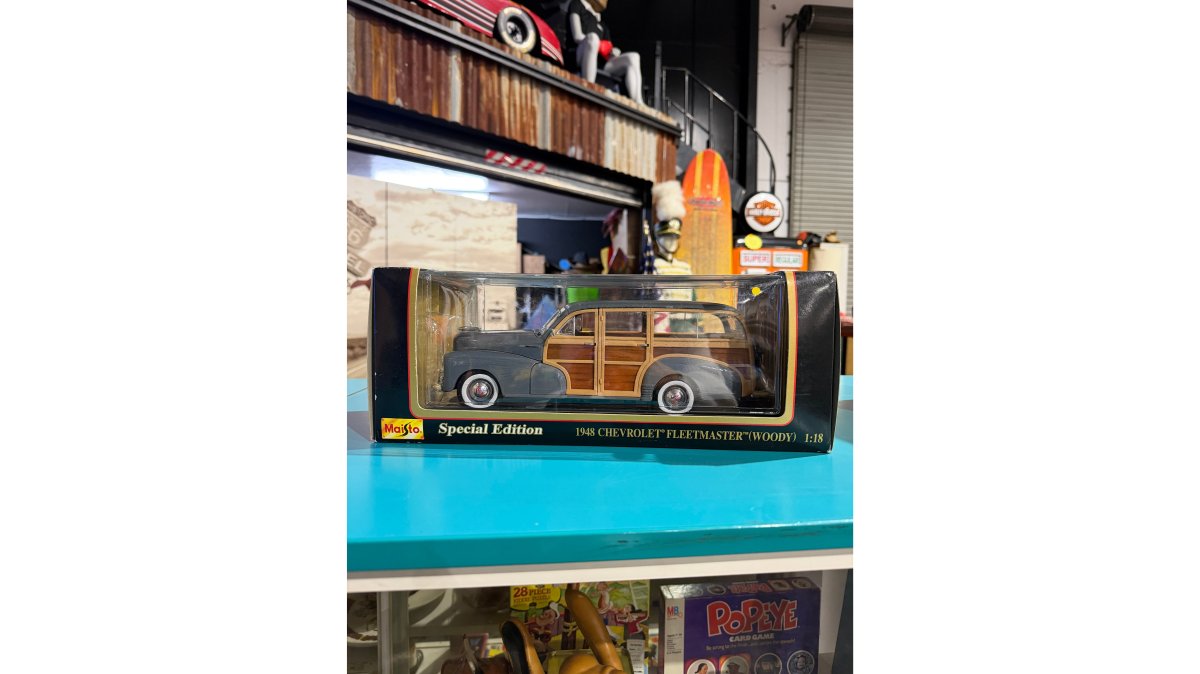
1948 Chevrolet Fleetmaster Woody 1:18
The 1:18 scale is the display sweet spot, large enough to show real detail, small enough to sit on a shelf without dominating the room. This Fleetmaster Woody captures the wood-panel styling that defined the post-war era.
Ford Woody Wagon
The Ford Woody Wagon offers the same woody aesthetic at $50.00, as a companion piece or a first model for someone new to collecting.
Vintage Automotive Decor for Home Bars, Garages and Dens
Vintage automotive decor works best when it follows a single era or marque. Mixing styles is the fastest way to make a space look cluttered rather than curated.
Neon Lights and Wall Hangings That Anchor a Room
Start with one anchor piece. The Hot Rod Neon Light at $50.00 gives a garage or bar an immediate focal point.

Route 66 and Petroliana Pieces for the Home Bar
Petroliana and Route 66 pieces carry the strongest nostalgia for most collectors. The Vintage Style Route 66 Case at $40.00 works on a bar shelf or as a gift.
How to Display Car Memorabilia Without Cluttering Your Space
Display and preservation are two halves of the same problem: a piece that looks good but degrades within a year is a temporary arrangement, not a collection. The choices that prevent clutter usually prevent damage too.
Start With a Layout, Not a Purchase
Before buying anything, photograph each wall and shelf you intend to use. Most collectors buy first and rearrange later, which is why dens end up crowded. The rule: one anchor piece per wall, one theme per zone, one clear gap between items. Negative space makes a collection look intentional rather than accumulated.
- Group by theme or marque, not by size
- Keep wall hangings at a consistent height, a single datum line across the room
- Leave at least a hand's width between mounted pieces
- Rotate seasonal or lesser pieces rather than displaying everything at once
- Keep lighting warm and low rather than bright and even
Displaying Fragile Items: Paper, Card and Photographs
Vintage manuals, race programmes, period posters and original photographs are the most vulnerable items in any collection. Paper degrades through three mechanisms: ultraviolet light, humidity and acid migration from poor-quality mounts.
- Frame behind UV-filtering glass or acrylic. Standard glass offers no UV protection.
- Use acid-free mounts and backing board. Ordinary cardboard and foam board are acidic and will stain paper over time.
- Keep framed paper away from direct sunlight and away from heaters or air-conditioning vents.
- Store loose items flat in acid-free folders, interleaved with archival tissue, in a cool, dry place.
- Avoid attics and garages for long-term paper storage, temperature swings and damp are the main causes of foxing and warping.
Displaying Metal Signs and Enamel Pieces
Enamel and tin signs are more robust but not indestructible. The main risks: edge rust, cleaning scratches, and stress fractures around mounting holes.
- Mount using the original holes where possible, with nylon washers behind the sign to avoid metal-on-metal contact.
- Do not drill new holes. Each new hole is a stress point and reduces value.
- Dust with a soft, dry cloth. Avoid abrasive cleaners and polishes, which can lift printed or painted surfaces.
- Keep signs out of damp rooms. Condensation on cold metal is the fastest route to edge rust.
Displaying Die-Cast Models and Scale Cars
Die-cast models are the easiest category to display well, but still need care: paint fades under direct sunlight, and dust settles into panel gaps and grilles.
- Use a closed display case or cabinet with a glass or acrylic front. Open shelving looks good but exposes models to dust and handling.
- Keep models out of direct sunlight. UV fades paint and discolours decals.
- Handle by the body, not the wheels, mirrors or aerials, which are the most common breakages.
- For long-term storage, wrap in acid-free tissue and keep in a dry, stable-temperature environment.
Displaying Neon and Illuminated Pieces
Neon and illuminated signs add atmosphere but introduce heat and electrical considerations. Keep them on a switched circuit, avoid tight cabinets where heat builds up, and check the transformer and wiring periodically for cracking or discolouration. If a piece runs hot to the touch, it is not suitable for continuous display.
The best display is one you can maintain. If a piece is difficult to dust, hard to reach or exposed to direct sun, it will not stay in good condition, and a collection that degrades is a collection that loses value.
Authenticity, Provenance and Sustainability in Memorabilia
Most buying guides treat authenticity as a footnote. In practice, it is the biggest determinant of whether a piece holds its appeal or ends up in a box. Reproduction signage, reprint posters and modern castings are everywhere, many sold without disclosure that they are new.
How to Tell a Genuine Piece from a Modern Reproduction
Start with materials. Genuine mid-century enamel signs were fired at high temperature, so the colour sits under a glass-like surface rather than on top of it. Run a fingernail gently across the edge: a modern vinyl or printed reproduction will catch, while fired enamel feels continuous with the metal. Weight is the second tell.
What Provenance Actually Looks Like
Provenance is not a certificate but a documented chain explaining where a piece came from. Useful provenance includes:
- Original receipts, dealer invoices or auction house lot slips
- Manufacturer catalogues or period advertisements that match the item exactly
- Photographs of the piece in its original setting
- A written account from the previous owner, even a short one
Red Flags Worth Walking Away From
- Prices that are dramatically below the going rate for the category
- Listings that use the words "style", "replica" or "inspired by" but present the item as original
- Sellers who cannot say what the item is made from
- Photographs that avoid the back, the edges or the maker's mark
If a seller refuses to provide additional photographs of the reverse, the edges or any maker's mark, treat that as a refusal to verify. A genuine seller has nothing to hide.
Sustainability Is a By-Product of Buying Well
Quality memorabilia is inherently more sustainable than disposable decor. A well-made enamel sign, solid die-cast model or bound manual can last decades with basic care, while printed reproductions fade within a season and end up in landfill. Buying fewer, better pieces and maintaining them is the most practical environmental choice a collector can make, and the same choice that protects value.
Budget-Tiered Gift Curation for Car Enthusiasts
- Under $50: The Vintage Style Route 66 Case at $40.00 suits a colleague, a secret Santa or a first gift.
- Around $50: Wall hangings, the Vintage Car Stein, the Ford Woody Wagon and the Hot Rod Neon Light all sit at $50.00. This is the core gifting tier and covers most occasions.
- Around $75: The 1948 Chevrolet Fleetmaster Woody 1:18 is the statement gift. It suits a milestone birthday or a close friend who collects seriously.
Do not buy a wall hanging for someone without knowing their wall space. A Mopar piece for a Ford household, or a large sign for a small flat, is a gift that stays in its box.

For broader context on how collectables hold value over time, Arts Law Centre of Australia guidance on collecting and provenance offers useful background for new collectors.
Conclusion
Building a collection that actually looks good takes more discipline than most people expect. Buying everything at once is exactly what turns a den into a storage room.
Frequently Asked Questions
What are some good gifts for a classic car enthusiast?
Start with the space they actually use. A Hot Rod Neon Light ($50) or a Route 66 Wall Hanging ($50) suits a garage or bar, while a Vintage Car Stein ($50) works for a den or office. For collectors, a 1948 Chevrolet Fleetmaster Woody 1:18 ($75) is a display piece rather than a trinket. Match the gift to their favourite marque where you can, and check the piece suits the room's existing look before buying.
How do I choose authentic-looking classic memorabilia for home display?
Look at how the piece is made, not just how it photographs. Check the weight, the finish, and whether the branding is period-correct rather than a modern logo dropped onto a vintage shape. Ask the seller where the item came from and whether it is a reproduction or an original. Genuine classic memorabilia for car enthusiasts should hold up to close inspection, not just look right from across the room.
What types of vintage automotive decor for home garages are most popular?
Wall hangings and signage lead the way because they fill vertical space without eating floor area. Shelby, Ford, Mopar and Used Cars wall hangings (all $50) give a garage a workshop aesthetic without a full renovation. Neon lights add a focal point above a bar or bench. Smaller pieces like the Vintage Style Route 66 Case ($40) work on shelves and benches where larger items would crowd the space.
How should I display car memorabilia in a small space?
Group pieces by theme rather than spreading them out. Pick one wall as the focus, hang two or three related items at eye level, and leave the rest of the room plain. Keep scale in mind: a large wall hanging in a small garage can overwhelm it, while a cluster of smaller pieces reads as a curated collection. Rotate items seasonally if you own more than you can show at once.
What makes a piece of classic memorabilia a good investment?
Scarcity, condition and provenance do most of the work. Limited edition runs, original period pieces and items with documented history hold value better than open-ended reproductions. Condition matters as much as rarity, so store pieces away from direct sun and damp. Buy what you genuinely enjoy displaying first; classic memorabilia for car enthusiasts is a hobby before it is an asset, and taste-led purchases rarely disappoint.
A collection grows best when each piece earns its place. Whether you are starting with a single wall hanging or adding a centrepiece model, the goal stays the same: a space that feels considered rather than crowded. Browse the Lost America Cool Classic Collectables range and find the piece that anchors your room.