
Table of Contents
- Why Mid Century Americana Still Captivates Collectors
- Identifying Authentic Mid-Century Modern Furniture
- How to Date Vintage Americana Clothing
- Valuing Vintage Americana Collectibles
- Spotting Reproductions and Counterfeit Mid Century Americana
- Caring for and Displaying Your Collection
- The Logistics of Collecting Large Mid Century Americana Items
- Insuring and Protecting Your Mid Century Americana Collection
- Frequently Asked Questions
Last Updated: September 30, 2026
Why Mid Century Americana Still Captivates Collectors
Collecting mid century americana items is the practice of acquiring objects made between roughly 1945 and 1969 that carry a distinctly American design identity: chrome diner fittings, salt-glazed stoneware, figural dishes, teak and walnut furniture, neon signage, and the everyday industrial design that followed the war. At Lost America Cool Classic Collectables, we see the appeal in the objects themselves: they were built to last, and most were built to be used.
Powerhouse Museum collection guides on twentieth-century design
Identifying Authentic Mid-Century Modern Furniture
Authentic mid-century modern furniture is identified by its joinery, materials, and maker's marks, not by its silhouette alone. Reproductions copy the shape; they rarely copy the construction.
Joinery, Materials and Maker's Marks
Start underneath. Genuine pieces from the era typically use solid timber frames with visible, well-finished joints. Look for mortise-and-tenon and dovetail work, and check whether the underside has been sanded and sealed. A common mistake is judging from the front only.
- Check the underside and back, not just the visible surfaces
- Confirm the timber matches the era and the maker
- Look for a stamp, label, or stencil in a consistent location
- Feel the weight: solid timber carries heft that veneer over particleboard does not
How to Date Vintage Americana Clothing
Dating vintage americana clothing comes down to four clues read together: the label, the fastenings, the fabric, and the construction. Any single clue can mislead, so treat them as a set rather than a checklist.
Labels and Union Marks
Labels are the fastest starting point, and the wording matters more than the brand name. Country-of-origin phrasing, care-instruction wording, and fibre-content disclosure all shifted across the period, and the typeface and stitching of a label often narrow a garment to a rough decade. Woven labels generally sit earlier than printed ones; paper tags stitched at the side seam tend to sit later.
Zippers, Buttons and Fastenings
Zippers are the second-strongest clue. Early metal zippers with large teeth and branded pulls sit earlier than later nylon examples, and the move from metal to nylon across the period is well documented by the major zip manufacturers. Look at the pull shape, the tooth material, and whether the tape is cotton or synthetic.
Fabric and Construction Clues
Fabric tells the rest of the story. Early synthetics, blended weaves, and the weight of the cloth all shift across the period, and the hand-feel of a genuine era fabric is hard to fake. Feel the seams, too. Hand-finished seams and pinked edges point earlier; overlocked and serged edges point later. Check whether the lining is attached by machine or by hand, and whether the hem has been let down or taken in.
- Read the label wording, typeface, and stitching method
- Check the inside side seam and collar back for a union mark
- Inspect zipper teeth, pull, tape, and branding
- Identify the fibre, its weave, and its hand-feel
- Compare seam finishing and hem work against the label's claimed era
National Gallery of Victoria fashion and textiles research
Valuing Vintage Americana Collectibles
Valuing vintage americana collectibles depends on three variables: condition, provenance, and current market demand. Get all three right and you have a defensible number.
Condition, Provenance and Market Demand
Condition is the biggest lever. Original finish, intact hardware, and honest patina lift value; refinishing and replaced parts pull it down. Provenance, meaning the documented history of an item, adds a premium when it is verifiable rather than claimed. Demand shifts with taste, so a piece that sat unsold two years ago can move quickly today.
| Factor | What to Check | Effect on Value |
|---|---|---|
| Condition | Original finish, intact hardware | Strongest single driver |
| Provenance | Receipts, auction records, papers | Adds a premium when verified |
| Demand | Recent comparable sales | Shifts with collector taste |
| Rarity | Production numbers, surviving examples | Matters less than condition |
Spotting Reproductions and Counterfeit Mid Century Americana
Most guides to this category stop at aesthetics. That is a mistake. Reproductions and counterfeits are the biggest financial risk in mid century americana, and they are getting better every year. The giveaway is almost never the shape. It is the construction, the hardware, and the wear pattern. This section is written for collectors who want to buy with confidence rather than hope.
Why Reproductions Are Getting Harder to Spot
A generation of well-made revival furniture and decor has now aged into the same visual territory as the originals. Silhouettes are easy to copy; joinery, hardware, and honest wear are not. The result is a market where the shape is right, the finish is plausible, and the piece is still wrong. Serious collectors learn to inspect in a fixed order, underside, hardware, wear, then surface, because that order exposes fakes fastest.
Construction and Hardware Tells
Start underneath. Genuine pieces from the era typically use solid timber frames with visible, well-finished joints. Reproductions often use modern screws, Phillips-head fasteners, and particleboard or plywood where the original used solid stock. Look for mortise-and-tenon and dovetail work, and check whether the underside has been sanded and sealed. A common mistake is judging from the front only.
Vintage Coke Vending Machine →
Fake Patina and Wear Patterns
Fake patina is a common tell. Genuine wear is uneven and follows use: worn armrests, faded sun-facing surfaces, scuffed feet, and darkened edges where hands actually rested. Applied distressing looks uniform and sits in the wrong places, scuffs on surfaces nothing would touch, uniform fading across a piece that would have been partly shaded, and grime in crevices rather than on contact points.
Maker's Marks, Labels and Paperwork
Maker's marks, brand stamps, or paper labels on the underside or rear rail confirm origin. A stamp can be worn, but its position and method of application should match the maker's known practice. Reproductions often place a mark in the wrong location, use the wrong typeface, or apply it in a way the original maker never did.
- Check the underside and back, not just the visible surfaces
- Confirm the timber matches the era and the maker
- Look for a stamp, label, or stencil in a consistent location
- Feel the weight: solid timber carries heft that veneer over particleboard does not
- Inspect fasteners with a magnet and a torch
- Compare wear patterns against how the piece would actually have been used
Caring for and Displaying Your Collection
Caring for a collection is mostly about controlling light, humidity, and handling. Do the simple things consistently and most pieces will outlast you.
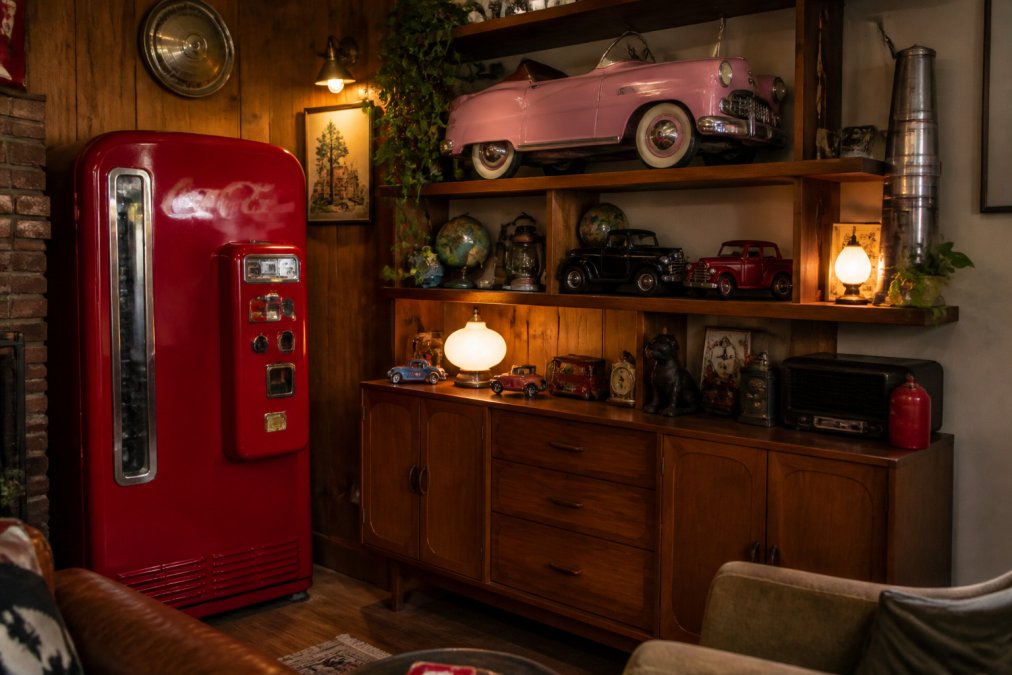
The Logistics of Collecting Large Mid Century Americana Items
Large items break more collections than budgets do. Vending machines, pedal cars, and full-size signage all need transport, space, and a plan before purchase.
Insuring and Protecting Your Mid Century Americana Collection
Insuring a collection means documenting it before you need to claim. Photograph every piece, record dimensions and any marks, and keep receipts and appraisals together in one file.
Australian Securities and Investments Commission guidance on insurance
Frequently Asked Questions
What defines authentic mid-century Americana decor?
Authentic mid-century Americana decor spans roughly 1945 to 1969 and combines clean modernist lines with American commercial imagery. Think teak and walnut furniture, art pottery, salt-glazed stoneware, flow blue china and advertising pieces such as vintage Coke vending machines, pedal cars and petrol station signs. Original items show genuine patina, period-accurate hardware and maker's marks consistent with the era. Reproductions often use modern screws, uniform finishes and synthetic materials that did not exist at the time.
How do I distinguish between original mid-century items and modern reproductions?
Check the details a factory would not fake. Original mid-century furniture uses joinery such as dovetails and mortise-and-tenon, not Phillips-head screws. Look at the patina: genuine wear is uneven and follows how the piece was used. Inspect labels and stamps against known maker's marks. On smaller collectibles, weigh the item; originals are often heavier or lighter than expected due to period materials. If the price seems too low for a rare find, treat it as a warning sign and ask for provenance.
What are the most sought-after mid-century Americana collectibles?
Demand centres on pieces with strong visual identity and documented history. Vintage vending machines, pedal cars, neon signs, art pottery, figural dishes and iridescent vases all attract collectors. Items tied to classic car culture, diners and roadside Americana hold steady value. Limited production runs and pieces with original advertising artwork tend to appreciate fastest. Condition matters most: a rare item in poor shape often sells for less than a common item in excellent original condition.
How should I care for and preserve vintage Americana items?
Keep pieces out of direct sunlight, which fades paint and breaks down upholstery. Maintain stable humidity between 40 and 50 percent to prevent wood grain from cracking and metal from rusting. Dust with a soft cloth rather than harsh cleaners. For wood, use a pH-neutral wax sparingly. Store textiles flat with acid-free tissue. If a piece needs restoration, consult a specialist before acting; poor restoration can cut value by half or more.
Where can I find reputable sources for mid-century Americana in the local market?
Estate sales, auction houses and specialist dealers remain the most reliable sources. Established dealers often provide provenance documentation and condition reports. Online marketplaces can work well if the seller offers clear photographs and return policies. Visit in person where possible, especially for large items such as vending machines or pedal cars, so you can inspect construction and patina before committing.
What is the historical significance of mid-century Americana design?
Mid-century Americana reflects the post-war boom in consumer culture, suburban living and mass production. Designers blended Scandinavian influence with American industrial design, producing furniture, pottery and advertising that prioritised function and optimism. The era's aesthetic appeal endures because it captures a specific moment of prosperity and confidence. Collectors value these pieces not only for craftsmanship but for the cultural story they carry.
Building a collection that looks intentional rather than accidental takes patience, good documentation, and a willingness to walk away from anything you cannot verify. Lost America Cool Classic Collectables curates vintage-inspired pieces and classic memorabilia for exactly that purpose, with pick-up options on larger items and a focus on nostalgic decor that earns its space. Browse the collection and find the piece that anchors your room.