
Table of Contents
- Define Your Home Bar Theme Before You Buy Anything
- Choosing the Right Spot: Nooks, Carts, and Full Bars
- Styling a Bar Cart for Beginners: Start With These Essentials
- Glassware, Tools, and the Spirit Collection
- Lighting and Materials That Set the Mood
- Avoiding Clutter With Vintage Home Decor: The 3-Tier Rule
- Finishing Touches: Art, Objects, and Personal Story
- Conclusion: Your Home Bar Theme, Ready to Pour
- Frequently Asked Questions
Last Updated: September 5, 2026
A home bar theme is the unifying visual and functional concept that ties your spirits, glassware, and decor into one intentional, personal space. Most people start by buying a few bottles and a shaker, then wonder why the corner feels like clutter. Curating a theme reverses that order: you decide on the story first, and every purchase earns its place in it.
You do not need bespoke cabinetry or a plumbed sink to get the look. What you need is a clear point of view and a disciplined approach to editing what goes on display.
Define Your Home Bar Theme Before You Buy Anything
Start with a single sentence describing the mood you want, a 1950s Americana diner, a moody 1970s lounge, or a clean mid-century modern den. That sentence becomes your filter for every subsequent decision, from colour scheme to decanter style.
Anchor the theme with a reference point: a decade, a film, a road trip route, or a specific car model. Vintage car enthusiasts often build a bar around the colours and chrome of a favourite classic, leading to a cohesive palette of deep reds, cream, and polished metal.
Keep your theme sentence visible while you shop. When considering a piece, ask whether it belongs in that story; if it does not, it does not come home. This habit prevents the random accumulation that turns a styled space into a storage shelf.
Choosing the Right Spot: Nooks, Carts, and Full Bars
Your location determines how much you can display and how the space functions. A full built-in bar suits dedicated entertaining rooms, but most homes lack that luxury. A compact corner of a living room or den works just as well when styled properly.
A bar cart is the most flexible option for beginners, letting you test a theme without committing to permanent furniture and move it between rooms as needed. For small spaces, use a narrow console table against a wall, topped with a mirror to visually double the display area.
A room divider can define a bar zone in an open-plan layout. Position a shelving unit perpendicular to the wall to create a distinct nook, then layer bottles and glassware on the open shelves, the feeling of a dedicated bar without construction.
Styling a Bar Cart for Beginners: Start With These Essentials
Styling a bar cart for beginners comes down to a simple formula: one level for pouring, one for drinking, one for decoration. The top tier holds spirits and tools, the middle holds glassware, and the bottom stores backups, mixers, or a cocktail book.
Begin with a maximum of five bottles: one per spirit category that fits your theme, plus a bottle with a distinctive colour or label shape. Crowding the cart defeats the purpose of curation.
The cart itself should not compete with what is on it. A brass or chrome frame reads mid-century; dark wood suits a clubby, traditional look. Keep styling loose and asymmetrical, a perfectly symmetrical cart looks like a retail display.
Glassware, Tools, and the Spirit Collection
The bar tools you choose should reflect the same era as your theme, but the deeper question is whether your theme matches the drinks you serve. The theme should extend to the cocktails themselves: a 1950s Americana diner theme calls for highballs and old fashioneds, while a moody 1970s lounge suits martinis and sidecars. If you build a Tiki theme but stock only whisky, the space will feel wrong no matter how well you style the shelves.
Matching Glassware to the Theme and the Drink
Start with the three glasses that cover 80% of classic cocktails: the rocks glass, the highball, and the coupe. For a 1950s Americana theme, look for heavy-base rocks glasses with a thick rim, the kind found in a roadside diner. For a 1970s lounge, a stemmed coupe with a wide, shallow bowl is the signature glass.
Vintage glassware adds instant character. Look for cut crystal tumblers, coloured juice glasses, or etched cocktail coupes at op shops and flea markets. Mixing and matching is fine as long as pieces share a similar era or colour family. A set of six matching 1960s coupes can often be found for $20-$40 at a Salvos or Vinnies store, whereas a new designer set costs $100 or more (thespruce.com).
Tools That Earn Their Place
A weighted brass shaker set and a vintage-style ice bucket do more for a 1950s look than a modern stainless steel kit ever will. Prioritise tools you actually use: a shaker, a jigger, a strainer, and a long spoon cover most classic cocktails. For a 1970s lounge, a Boston shaker with a separate mixing glass is more era-appropriate than a cobbler shaker. For a Tiki theme, a swizzle stick and muddler become essential.
The Thematic Spirit Collection
Your spirits collection is the functional heart of the bar, but it also contributes to the aesthetic. Stock spirits that match the cocktails your theme implies: for a 1950s Americana theme, bourbon, rye, and a good quality gin; for a 1970s lounge, vodka and vermouth; for a Tiki theme, multiple styles of rum and orange liqueur.
Decanters are the simplest way to unify mismatched bottles. Transfer everyday bourbon or whisky into a matching set of glass decanters, and the shelf instantly looks intentional. But do not decant everything, keep frequently used bottles within easy reach and reserve decanters for spirits you pour less often. A common pattern is to decant the 'everyday' bottle and keep the 'special occasion' bottle in its original packaging as a deliberate display piece.
The Seasonal Swap Strategy
A unique angle most guides ignore is the modular theme, a bar that shifts with the seasons without a full restyle. Keep a core collection of tools and glassware that works year-round, then swap out three or four accent pieces to change the mood. In summer, bring forward gin and light rums, add citrus-forward bitters, and display highball glasses. In winter, push whisky and dark rum to the front, add Angostura bitters, and swap in rocks glasses.
Store off-season bottles in a cupboard or closed cabinet below the bar. The visible shelf should never hold more than five to seven bottles, enough to signal a curated collection, not a liquor store. When the season changes, rotate bottles and swap two or three decorative objects (vintage matchbooks for summer, a small ceramic tree for winter) and the theme shifts without a single new purchase.
Lighting and Materials That Set the Mood
Lighting is the single most important element in making a home bar theme feel atmospheric, but the difference between a good bar and a great one comes down to layering. Overhead ceiling lights flatten the space and wash out warm tones. Instead, build a three-tier lighting plan that mimics classic cocktail lounges.
Tier one: ambient glow. A small table lamp with a low-wattage bulb (40-60W equivalent) on a side table or the bar creates a warm pool of light. Choose a fabric shade in cream, amber, or deep red. Alternatively, install a dimmer switch on your existing overhead circuit, a swap that costs under $50 at Bunnings and takes ten minutes.
Tier two: accent lighting. Backlit shelving or a small neon sign catches the liquid in bottles and reflects off cut glass. For a 1950s Americana theme, a vintage-style neon sign in warm amber or soft red is the single most effective purchase you can make. For a mid-century modern look, use LED strip lighting with a warm white (2700K) colour temperature under the lip of each shelf (energy.gov). Avoid cool white or blue light, it makes spirits look flat and casts a clinical tone.
Tier three: task lighting. A small, directional clip-on light or miniature architect lamp over the mixing area provides focused illumination without ruining the mood. This is the layer most home bars miss, the difference between a bar that looks good in photos and one that works well at a party.
Choosing Materials That Ground the Theme
The countertop material matters more than most people expect. A dark timber or marble-look surface grounds the bar and gives bottles something to stand against. Avoid light, glossy surfaces that reflect too much and feel clinical.
For a budget-conscious approach, you do not need to renovate. A sheet of 19mm blackbutt or spotted gum timber from a hardware store, cut to size and finished with danish oil, costs around $60-$90 and can sit on top of an existing sideboard or console. For a 1970s lounge theme, consider dark laminate or a remnant piece of engineered stone from a local stonemason, many sell offcuts for under $100.
For the backsplash, dark tile, pressed tin, or timber panelling absorbs light rather than bouncing it harshly. Pressed tin panels are available from specialty suppliers and can be cut to fit a small area for around $50-$80. If you are renting, use removable adhesive tiles or lean a large piece of timber against the wall behind the bar, it reads as intentional design rather than a compromise.
The Budget-Conscious Lighting Hack
Most high-end guides assume you have the budget for custom joinery and electricians. If you do not, use a simple plug-in dimmer switch (available from Bunnings or Spotlight for around $30) on a standard floor lamp placed behind the bar. Angle the shade upward so the light bounces off the wall and ceiling, creating a soft, diffuse glow. This single $30 purchase does more for the atmosphere than a $500 renovation feature.
Avoiding Clutter With Vintage Home Decor: The 3-Tier Rule
Avoiding clutter with vintage home decor requires a different mindset than buying new items. Vintage pieces carry visual weight, so they need breathing room. The 3-Tier Rule keeps any shelf or surface balanced: arrange items in three height levels, with the tallest at the back or centre, the shortest at the front, and the middle tier filling the gap.
Apply the rule to every surface in the bar. On a shelf, place decanters and larger bottles at the back, glassware in the middle, and small objects like match strikers or vintage tin signs at the front. This creates a layered look that reads as curated rather than crowded.
Edit ruthlessly. If a shelf holds more than three distinct groups of objects, remove one group. Empty space is a design tool, not wasted area. The goal is a collection that looks assembled over years with intention, not a hoard of interesting things with nowhere to go.
| Surface | Tier 1 (Back) | Tier 2 (Middle) | Tier 3 (Front) |
|---|---|---|---|
| Open shelf | Decanters, tall bottles | Glassware, shaker set | Small objects, tin signs |
| Bar cart top | Spirit bottles | Tools, jigger | Ice bucket, match striker |
| Countertop | Backlit sign, artwork | Mixing glass | Coasters, small figurines |
Finishing Touches: Art, Objects, and Personal Story
The final layer transforms a functional bar into a personal space. Statement artwork, a vintage advertisement, a framed map, or a classic car print, anchors the wall above the bar and reinforces the theme. Choose one large piece rather than several small ones to avoid visual noise.
Decorative objects should tell a story. A model of a 1957 Chevrolet, a set of vintage enamel signs, or a collection of old matchbooks signal a specific interest and invite conversation. These objects are the difference between a bar styled by a shop and one lived in by a person.
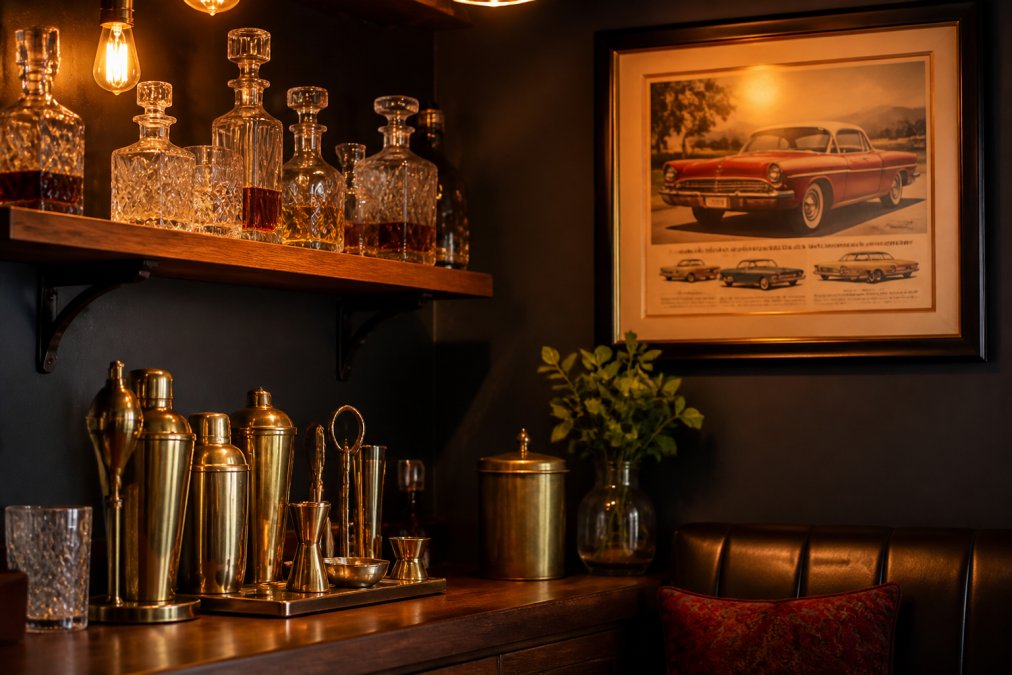
Arrange these pieces in odd numbers. Three objects grouped together always reads better than two or four. Vary the heights and textures, and leave some space between groups so the eye can rest. As noted in styling guidance from the National Trust for Historic Preservation, preserving the character of a space often means resisting the urge to fill every gap with an object.
Conclusion: Your Home Bar Theme, Ready to Pour
The challenge of curating a home bar theme is restraint, not acquisition. Every piece you add should earn its place by supporting the story you set out to tell, whether that is a 1950s roadside diner or a refined mid-century lounge. For unique pieces that anchor a nostalgic aesthetic, Lost America Cool Classic Collectables offers a curated selection of vintage-inspired decor, neon lights, and classic vehicle models that fit naturally into these themed spaces. With a clear theme and the 3-Tier Rule in place, the result is a bar that feels personal, inviting, and ready for its first pour. Shop the collection to find the statement pieces that complete your space.
Frequently Asked Questions
How do I make a home bar look good without it feeling cluttered?
Follow a simple 3-tier rule for every shelf: one large statement piece, two medium objects, and three small items. This gives the eye a place to rest. Group glassware together and keep bottles to a single row. Use trays to corral loose tools like stirrers and jiggers. Leave about 30 percent of each surface empty to create a sense of calm.
What are some creative themes for a home bar?
Good themes start with a personal interest, not a store-bought sign. Try a 1950s roadside diner look with chrome and red vinyl, a British members club with leather and brass, or a tropical tiki corner with bamboo and rattan. For a cohesive feel, pick one era and one colour palette, then stick to it across your glassware, decor, and artwork.
How do you balance vintage decor with modern functionality in a bar space?
Use vintage pieces for visual interest and modern items for daily use. A retro ice bucket can sit on display, while a modern blender stays tucked in a cabinet. Check that all electrical items meet Australian safety standards before plugging them in. If you collect vintage glassware, keep it on a high shelf to avoid accidental breakage during parties.
What are the best tips for styling a small home bar area?
Use a wall-mounted shelf or a slim bar cart to save floor space. Install open shelving above the cart to draw the eye upward and add storage without extra bulk. Choose a mirror behind the bottles to bounce light and make the corner feel larger. Keep your collection tight: display only the bottles you use regularly and store the rest elsewhere.
A well-curated home bar does not happen by accident. It requires deciding on a theme, editing your purchases, and arranging everything with intention. Lost America Cool Classic Collectables helps you source the vintage-inspired pieces that give your space character, from neon signs to classic car memorabilia, as highlighted in collecting guides from Antique Trader. Get started with Lost America Cool Classic Collectables and build a bar that tells your story.