
Table of Contents
- Why Authenticity Matters in Vintage Americana
- Start With the Label and Tags
- Read the Fabric and Texture
- Inspect Stitching, Zippers, and Hardware
- Identifying Vintage Manufacturing Marks
- How to Spot Fake Vintage Decor
- Value of Authentic Vintage Collectibles 2026
- Build Your Collection With Confidence
- Frequently Asked Questions
Last Updated: September 9, 2026
Why Authenticity Matters in Vintage Americana
Authentic vintage americana is more than an old object; it is a physical document of American manufacturing history. For collectors, the difference between a genuine 1950s piece and a modern reproduction is about the integrity of the design, the quality of the materials, and the story the item tells. This guide breaks down the practical steps for verifying what you hold in your hands.
The market is flooded with items that merely look the part, so understanding how to identify authentic vintage americana protects your investment and your collection's credibility. Many newcomers assume an aged appearance is proof of provenance, yet distressing techniques can fool the untrained eye.
The real markers of authenticity live in the construction: the weave of the fabric, the cast of the hardware, and the specific typography of a manufacturer's tag. This guide will explore the strategies serious collectors use to verify their finds, from label analysis to material science testing.
Start With the Label and Tags
The label is the first and most reliable witness to an item's origin. On authentic vintage americana, the manufacturer's tag should show signs of age consistent with the garment or decor piece itself, including natural fading, slight fraying at the edges, and stitching that uses the same thread type and colour as the garment's main construction.
Mid-century tags typically list a city and state, sometimes a union label, and often a style or lot number. Reproduction tags frequently use modern fonts, lack the union bug, or contain anachronistic details like "made in USA" in a typeface that didn't exist during the claimed era. If the tag looks too crisp and the fabric around it shows heavy wear, that is a red flag.
Check how the tag is attached. Genuine vintage items use specific stitch patterns that match the era of production. A tag sewn with a modern overlock stitch on a garment claiming to be from the 1940s is a clear sign of a reproduction.
Read the Fabric and Texture
Fabric composition is where material science testing begins to separate the genuine article from the imitation. Authentic vintage americana relies heavily on natural fibres like heavyweight cotton duck, wool melton, and full-grain leather. If a piece claims to be from before 1960 but feels like a synthetic blend, it is almost certainly a reproduction. But feeling is not enough; serious collectors use simple, low-risk tests to confirm fibre content.
The Burn Test: A Practical First Step
A common pattern among collectors is to perform a burn test on a loose thread or a fibre pulled from an inconspicuous seam. This is a destructive test, so it should only be done on a thread you can afford to lose, and always with tweezers over a fireproof surface. The reaction of the fibre to flame is highly diagnostic:
- Cotton and linen (plant fibres): Burn quickly with a bright, steady flame, leaving a fine, grey ash that crumbles easily. The smell is reminiscent of burning paper or leaves.
- Wool and silk (animal fibres): Are more resistant to flame and tend to curl away from it. They burn slowly, often self-extinguishing, and produce a hard, black, bead-like residue. The odour is unmistakably like burning hair or feathers.
- Polyester and nylon (synthetics): Melt and shrink away from the flame, often dripping hot, molten plastic. The residue is a hard, plastic bead, and the smell is acrid and chemical.
If a supposedly 1940s wool jacket produces a plastic bead when tested, the fibre content is an anachronism. This test provides a level of certainty that visual inspection alone cannot match.
The Texture of Time
Vintage denim from the 1950s has a slubby, irregular weave that modern mass-production rarely replicates. Genuine vintage fabric often feels denser and more substantial because it was woven on older looms at slower speeds. Synthetics like polyester were introduced to mainstream workwear in the late 1960s, so their presence in a supposed 1940s jacket is a factual impossibility.
Natural fibre breakdown is another clue. Cotton and wool degrade over decades, becoming softer and slightly thinner in high-friction areas. This type of wear, called patina, develops unevenly. A reproduction that has been artificially distressed usually shows uniform wear patterns that do not match how a human body actually moves. Look for fading concentrated at the collar, cuffs, and seat, which indicates genuine use over time.
A Note on Modern Blends
A critical nuance is the introduction of synthetic blends. While 100% synthetics are a clear red flag for pre-1960 items, blends like a 65% polyester/35% cotton mix were common in the late 1960s and 1970s. Finding such a blend does not automatically mean an item is fake; it simply narrows the manufacturing era to the late 1960s or later.
Inspect Stitching, Zippers, and Hardware
The hardware on authentic vintage americana functions as a timestamp for the item's production era. Zippers are particularly diagnostic: a Talon zipper with a specific pull design can date a garment to within a few years of its manufacture. Before the 1950s, most zippers were made of brass or nickel-plated steel, and they were heavier and bulkier than modern equivalents.
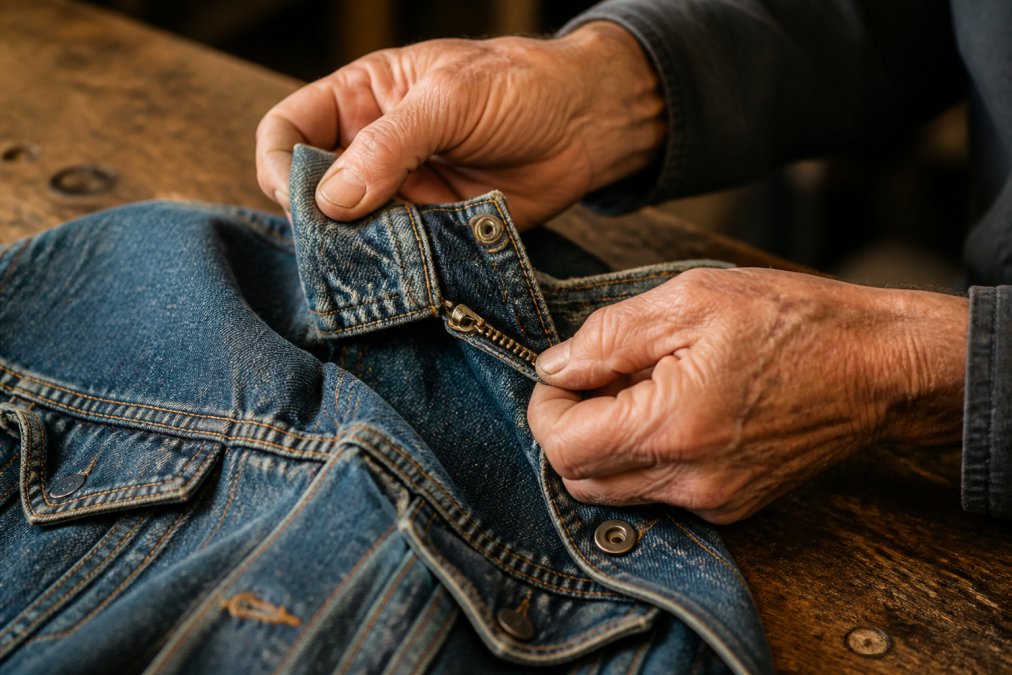
Vintage garments were often constructed with 8 to 12 stitches per inch using heavy-duty thread, while modern reproductions frequently use fewer to cut costs. Turn the garment inside out and examine the seams. Genuine vintage pieces show consistent, tight stitching with no loose threads, using techniques like flat-felled seams that are rarely used in modern fast fashion.
Look for the manufacturer's name stamped on the back of the hardware. In the mid-20th century, companies like Scovill and United Carr produced most of the snaps used in American workwear. If the hardware is unmarked or has a modern logo, the item is likely a reproduction. Vintage hardware is generally heavier and has a distinct patina that is difficult to replicate convincingly.
Identifying Vintage Manufacturing Marks
Beyond the main label, authentic vintage americana often carries secondary marks that confirm its provenance. These include union labels, patent dates, and factory stamps that were required or customary during specific periods. The International Ladies' Garment Workers' Union label, for example, was common on American-made garments from the 1930s through the 1970s, and its specific design changed over the decades.
The manufacturing era can be pinpointed by the presence or absence of certain codes. A "RN" (Registered Identification Number) on a tag indicates the item was made after 1959, when the Federal Trade Commission introduced the system. If a seller claims a piece is from the 1940s but it has an RN number, the provenance is wrong. Similarly, the presence of a "CA" number suggests production after 1960, when California introduced its own registration system.
Mid-century tags were typically screen-printed or woven with a jacquard loom. Modern reproductions often use cheaper heat-transfer printing that cracks and peels differently than genuine age-related wear. The colour palette of the tag is also a clue; authentic vintage americana uses period-specific dyes with a saturation and depth that is difficult to match with modern inks.
How to Spot Fake Vintage Decor
Spotting fake vintage decor requires a shift in focus from the item itself to the context of its production. Many reproductions are made in factories that use modern casting and moulding techniques, which leave telltale signs like sharp edges and uniform surfaces. Authentic vintage decor, such as enamel signs or tin advertising, was often stamped or screen-printed, resulting in slight imperfections that are absent in modern copies.
Look for the patina of age on decor items. On a genuine vintage sign, the paint will have crazing, a fine network of cracks that develops over decades as the paint expands and contracts. Rust on metal edges should be brown and granular, not black and smooth. Artificial ageing with acid or sandpaper produces a different texture that is detectable under close inspection.
The weight of a piece is a strong indicator of authenticity. Vintage decor was built to last, using thicker gauge metal and heavier materials than today's cost-conscious reproductions. If a supposed 1950s tin sign feels flimsy or lightweight, it is likely a modern import. Similarly, check the edges of the metal; vintage pieces were often cut with shears, leaving a slightly rough edge, while modern pieces are laser-cut for a perfectly smooth finish.
Value of Authentic Vintage Collectibles 2026
The value of authentic vintage collectibles 2026 is driven by rarity, condition, and provenance, but the market has shifted noticeably in recent years. Collectors are increasingly prioritising items with verifiable history over those in merely good condition. A piece with original paint, original hardware, and a documented chain of ownership will consistently outperform a restored example at auction.
Understanding the distinction between resale value and authenticity is critical. A reproduction may look convincing, but its resale value is a fraction of the genuine article. The Antiques Trade Gazette's market analysis confirms that authenticated pieces with clear provenance command significant premiums in the current market. When you buy authentic vintage americana, you are buying an asset that typically holds its value, whereas reproductions depreciate immediately.
The condition is graded on a scale that affects value directly. Mint condition pieces with original packaging are the rarest and most valuable. Excellent condition shows minimal wear, while good condition shows honest use that does not detract from the item's integrity. Poor condition pieces, even if authentic, have limited appeal to serious collectors. As documented in the Smithsonian's guide to collecting Americana, the condition of the original finish is often the single largest factor in determining an item's worth.
Build Your Collection With Confidence
Building a collection of authentic vintage americana is a skill that improves with practice and education. Start by focusing on a specific niche, such as mid-century advertising or 1950s workwear, and learn everything you can about that category. The more familiar you are with the standard details of a particular era, the easier it is to spot anomalies that indicate a reproduction.
Networking with other collectors and attending appraisal events is one of the fastest ways to train your eye. The Australian Antique and Art Dealers Association's resources offer guidance on connecting with reputable dealers and understanding market values. Handling genuine pieces regularly builds a tactile memory for fabric weight, hardware heft, and finish quality that no photograph can convey.
Digital Authentication Tools: The Modern Edge
While tactile knowledge remains paramount, a new generation of digital tools can provide objective data to support your instincts. These tools are not a replacement for your own research, but they are powerful allies in the verification process.
-
Macro Photography for Hardware and Stitching: A smartphone with a clip-on macro lens (available for under $30) can reveal details invisible to the naked eye. Photograph the stitching on a tag or the edge of a zipper pull at high magnification. You are looking for the uniform, machine-perfect edges of modern laser-cut hardware versus the slightly irregular, hand-finished edges of vintage die-cast pieces. This technique is particularly effective for examining the patina on brass snaps and buttons.
-
UV Light Testing for Repairs and Inks: A small UV torch is an inexpensive and essential tool. Under long-wave UV light, many modern synthetic fibres and optical brighteners used in modern inks and dyes will fluoresce brightly. Genuine vintage fabrics and period-correct inks, which predate these chemical brighteners, will generally appear dull or dark. This test is highly effective for spotting modern repairs or re-dyeing on an otherwise authentic piece.
-
Online Serial Number and Patent Databases: Many manufacturers stamped patent numbers or lot codes onto their hardware and labels. A quick search on the Google Patents database can help you date a specific patent number found on a zipper pull or a snap button. Similarly, the United States Patent and Trademark Office's database allows you to search for trademarks, which can help you verify when a specific logo was first used and when it was abandoned. Cross-referencing a patent date with the claimed era of the item is a powerful way to confirm or debunk a provenance story.
The Financial Stakes of Verification
The distinction between resale value and authenticity is critical. A reproduction may look convincing, but its resale value is a fraction of the genuine article. The Antiques Trade Gazette's market analysis confirms that authenticated pieces with clear provenance command significant premiums in the current market. When you buy authentic vintage americana, you are buying an asset that typically holds its value, whereas reproductions depreciate immediately.
Using these digital tools to verify a piece before purchase is a financial safeguard. A $50 macro lens can save you from a $500 mistake on a misrepresented jacket. A few minutes of searching a patent database can confirm the authenticity of a $2,000 slot machine. In a market where the difference between a genuine article and a clever fake can be thousands of dollars, these tools are an investment in your collection's integrity.

When you are ready to purchase, buy from sources that stand behind their items. At Lost America Cool Classic Collectables, we offer a curated selection of vintage-inspired items and classic memorabilia designed to transport you to a better time and place. Our collection features unique pieces ranging from antique-style decor and neon lights to classic vehicle models and nostalgic collectibles. For collectors seeking verified pieces, we offer items like the Vintage Mills Jackpot Slot Machine and the Vintage Coke Vending Machine, each representing the craftsmanship of their era.

Frequently Asked Questions
How can you tell if vintage Americana decor is authentic?
Start with the manufacturing marks. Look for maker stamps, patent numbers and date codes on the base or back of pieces. Check for genuine wear patterns like patina, light scratches and fading that occur naturally over decades. Reproduction pieces often have uniform distressing and lack the depth of age that authentic vintage Americana shows. Inspect hardware like zippers and hinges, as pre-1960s versions used materials and manufacturing techniques that are difficult to replicate convincingly.
What role does patina play in verifying the age of vintage collectibles?
Patina is one of the strongest indicators of age. Authentic vintage pieces develop a natural surface change from oxidation, handling and exposure to light. Look for uneven fading, small chips that reveal the original colour underneath, and a smoothness on frequently touched areas. Fake pieces often apply artificial distressing that looks uniform or sits oddly on the surface. Real patina develops over decades and cannot be rushed convincingly.
Does the material composition help identify authentic vintage items?
Yes. Before the 1960s, most Americana was made from natural fibres like cotton, wool and leather, with solid brass or steel hardware. If a piece claims to be from the 1940s but contains obvious synthetic materials or lightweight alloys, it is a reproduction. Learning which materials were common in each manufacturing era is one of the fastest ways to spot fakes, especially when combined with checking the manufacturing marks.
Authenticating vintage americana takes patience, but the reward is a collection with genuine history and lasting value. Start with the label, trust your hands on the fabric, and never overlook the hardware. When you are ready to add a verified piece to your space, explore the curated collection at Lost America Cool Classic Collectables and bring a piece of timeless Americana home.