
Table of Contents
- Why Classic Memorabilia Deserves More Than a Shelf
- The Best Display Cabinets for Memorabilia Collections
- How to Display Collectibles at Home Without the Clutter
- Vintage Automotive Decor Ideas That Anchor a Room
- Preserving Your Classic Memorabilia: Light, Dust, and Climate
- Sourcing Authentic Classic Memorabilia: What to Check
- Conclusion: Build a Display That Tells Your Story
- Frequently Asked Questions
Last Updated: September 6, 2026
Classic memorabilia is more than a collection of old objects; it is a tangible connection to a specific era, a piece of history you can hold in your hands. Whether it is a vintage automotive sign, a die-cast model, or a piece of mid-century Americana, the value of these pieces is tied directly to how you present them. This guide from Lost America Cool Classic Collectables explores how to elevate premium classic memorabilia for home display, blending aesthetic styling with the technical know-how required to protect your investment.
Why Classic Memorabilia Deserves More Than a Shelf
Most collections fail to impress not because the items are unremarkable, but because they are treated as clutter rather than curated exhibits. A scattered assortment of items on a standard bookshelf rarely captures the nostalgic weight these objects carry. The goal is to transform a personal collection into a visual anchor for a room, whether that is a home bar, a garage, or a dedicated den.
This is where the concept of professional curation changes the game. Instead of simply placing items side-by-side, you group them by theme, era, or visual weight. You consider negative space, sightlines, and the story the arrangement tells. A common mistake is overcrowding, which diminishes the impact of each piece. According to interior design principles from the Australian Institute of Architects, the effective display of objects relies on balance and contrast, not volume.
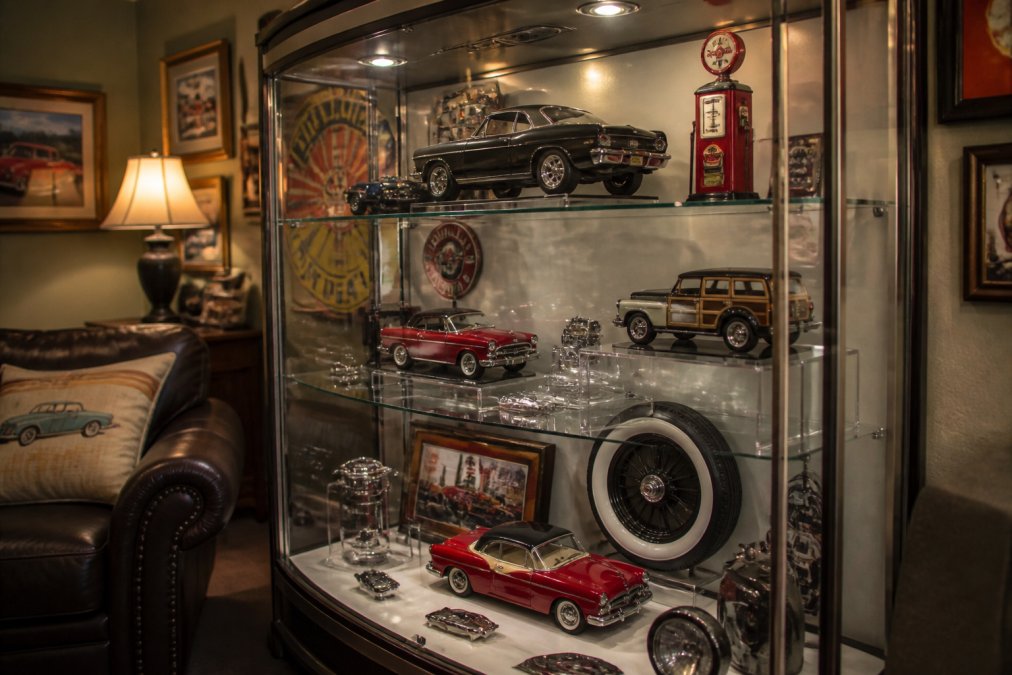
The Best Display Cabinets for Memorabilia Collections
A dedicated display cabinet is the single best investment you can make for your classic memorabilia. Unlike open shelving, a purpose-built unit offers protection from dust, accidental knocks, and the curious fingers of guests. Look for units with glass panels and internal lighting to create a museum-quality presentation that highlights your pieces without exposing them to the elements.
When selecting a cabinet, consider the scale of your items. Large automotive grilles or neon signs require tall, deep cases, while smaller items like vintage figurines and model cars benefit from tiered shelving. For smaller classic vehicle models and figurines, acrylic display risers from ShopPopDisplays offer UV-resistant protection and a clear, minimalist look that keeps the focus on the object itself. The key is to choose a system that is modular so you can adapt the layout as your collection grows.
How to Display Collectibles at Home Without the Clutter
The difference between a curated collection and a cluttered shelf is not the number of items, it is the application of deliberate design principles. Most advice stops at 'use odd numbers' and 'leave space,' but professional interior stylists and museum curators rely on a more structured framework. Applying these principles transforms a display from a storage solution into a designed focal point.
The Rule of Three, Applied with Intent
The 'rule of three' is a starting point, not a solution. The real mechanism is visual triangulation. When the eye lands on a group of three objects, it forms an invisible triangle, creating a sense of stability and completeness. For this to work, the three items must have a clear hierarchy: a primary object (the hero), a secondary object (the supporter), and a tertiary object (the finisher).
A common failure is grouping three items of equal height and visual weight. This creates a flat, monotonous line. Instead, vary the heights dramatically. Place a tall, slim item (like a vintage oil can) next to a low, wide item (like a die-cast model on a riser), and finish with a mid-height item (like a framed photograph leaned against the back). The goal is to create a dynamic silhouette that draws the eye across the arrangement.
Colour Theory: The 60-30-10 Rule
Borrowed from interior design, the 60-30-10 rule applies directly to memorabilia displays. Sixty percent of the visual field should be the background, the wall colour, the cabinet backing, or the shelf surface. Thirty percent should be the dominant colour of your collection, often the deep reds, blacks, or chrome of vintage automotive pieces. The final ten percent is the accent colour, a bright orange sign, a blue fuel pump, or a yellowed advertisement, that creates visual interest and prevents monotony.
When you understand this ratio, you can edit your collection with confidence. If every piece is a loud accent colour, the display becomes chaotic. If everything is muted, it becomes dull. The solution is to curate for colour balance, not just for theme. A collection of all-red signs will look like a retail display; mixing in black, chrome, and neutral tones creates a sophisticated, gallery-like feel.
Negative Space as a Design Element
Museum curators treat empty space as an active component of the display, not just an absence of items. Negative space gives each object room to 'breathe' and allows the eye to rest between focal points. A practical guideline is to leave at least 10-15 centimetres of clear space around each item on a shelf. For larger statement pieces, increase this to 20-30 centimetres.
This principle also applies to vertical spacing. Items should not touch the shelf above them, nor should they be crowded against the back of the cabinet. A common professional technique is to use clear acrylic risers to create varying depths, so items sit at different distances from the glass. This layered approach adds dimension and prevents the 'flat row' look that dominates amateur displays.
The 'One Era, One Story' Edit
Professional curation is ultimately about narrative. A display that mixes a 1950s fuel pump with a 1980s arcade sign and a 1920s brass instrument tells no single story. The most compelling collections are built around a tight thesis: 'The Golden Age of Australian Motoring,' 'The American Diner, 1940-1960,' or 'The Rise of the V8.'
This does not mean every piece must be from the same year. It means every piece should support the same narrative. A 1960s oil can sits comfortably next to a 1970s racing poster if both speak to the same motoring culture. A Victorian-era pocket watch does not. When you apply this editorial filter, you will find that 'clutter' is simply the result of too many competing stories in one space.
By applying these professional principles, triangulation, the 60-30-10 colour rule, deliberate negative space, and a single narrative, you move beyond 'styling tips' and into the realm of intentional design. The result is a display that looks curated, not accumulated.
Vintage Automotive Decor Ideas That Anchor a Room
Vintage automotive decor ideas often centre on a single, large statement piece that captures the spirit of the open road. A restored fuel pump, a porcelain enamel sign, or a polished chrome bumper can serve as the room's visual anchor. These large items carry significant visual weight, so they should be placed at eye level where they can be appreciated without dominating the space.
For those who prefer a more functional approach, consider integrating memorabilia into furniture. A bar cart built from a vintage car boot or a coffee table made from stacked tyres and glass adds character without looking like a storage room. Complement these large pieces with smaller accents, such as a hand-painted model car on a side table or a framed vintage advertisement on the wall. When sourcing these items, authenticity is paramount; a reproduction lacks the patina and story of an original piece.
Preserving Your Classic Memorabilia: Light, Dust, and Climate
Most display guides stop at 'keep it out of the sun.' For premium pieces, that advice is dangerously incomplete. The science of light damage goes far beyond simple UV rays, and understanding the mechanisms is what separates a collector from a custodian.
The Full Spectrum of Light Damage
UV radiation is the most aggressive threat, breaking molecular bonds in dyes, pigments, and polymers. However, visible light, specifically the blue-violet end of the spectrum (400-500 nm), also causes cumulative fading and yellowing. This is known as 'lux' damage, and it is why museums measure light exposure in lux-hours per year.
For a home display, the practical takeaway is this: position your cabinet away from direct window light, but also be wary of strong ambient light from skylights or high-output LED downlights. Use window film with a UV-blocking rating of 99% or higher on nearby glazing. For the display case itself, standard float glass blocks only about 45% of UV radiation. Opt for laminated glass or acrylic with a verified UV-filtering additive, these typically block 98-99% of UV rays. If you are unsure what your current case offers, a simple UV meter card can test the level of protection.
Humidity: The Silent Warper
Temperature fluctuations cause expansion and contraction, which stresses joints in wooden items and can cause paint to craze. Humidity is the more insidious variable. The Australian Museum's preservation guidelines recommend a stable relative humidity (RH) range of 40-55% for mixed collections (australian.museum). Below 40%, wood and paper become brittle; above 60%, you risk mould growth and metal corrosion.
In coastal Australian cities, summer humidity can easily exceed 70% indoors. A passive solution is to place silica gel sachets inside the cabinet, but these require regular recharging. For a serious collection, consider a small thermoelectric dehumidifier designed for display cabinets or gun safes. These units are silent, use minimal power, and hold a consistent RH level. Monitor conditions with a digital hygrometer placed inside the case, not on the wall outside it.
Dust and Handling Protocols
Dust is not just unsightly; it is abrasive. Microscopic particles of silica and skin cells can scratch polished surfaces and settle into the crevices of die-cast models. The Australian Museum recommends using a soft, lint-free microfiber cloth for regular dusting, but for intricate items, a soft-bristled brush (like a makeup brush or a dedicated anti-static brush) is more effective at lifting particles without pressing them into surfaces.
Handling is where most damage occurs. The oils and salts in human skin are mildly acidic and can etch metal finishes and corrode chrome over time. Wear white cotton or nitrile gloves when moving items. If gloves are impractical, wash and thoroughly dry your hands first, and hold items by their bases or edges, never by fragile appendages like antennas, mirrors, or grilles.
The 12-Month Rotation Cycle
Even with perfect conditions, all materials age. A professional conservation practice is to rotate displayed items every 6-12 months. This does more than refresh the look of your room; it limits the cumulative light exposure on any single piece. Items in storage should be wrapped in acid-free tissue paper and placed in archival boxes, not plastic tubs, which can trap moisture and cause off-gassing.
By treating preservation as a science rather than a set of vague cautions, you ensure your premium pieces retain both their monetary value and their visual integrity for decades.
Sourcing Authentic Classic Memorabilia: What to Check
The market for classic memorabilia is filled with reproductions, so knowing how to spot a genuine piece protects both your wallet and the integrity of your collection. Start by examining the materials. Vintage items often show signs of age, such as patina on metal, minor paint wear, or slightly yellowed paper. These imperfections are markers of authenticity, not flaws. A piece that looks too perfect may have been manufactured recently to appear old.
Check for manufacturer stamps, serial numbers, or date codes. These are difficult to replicate accurately and are strong indicators of a genuine item. Research the specific item you are looking for; understanding the original production details helps you spot inconsistencies. At Lost America Cool Classic Collectables, we offer a curated selection of vintage-inspired items and classic memorabilia designed to transport you to a better time and place. Our collection features unique pieces ranging from antique-style decor and neon lights to classic vehicle models and nostalgic collectibles. When buying online, ask for detailed photos of the back and edges of the item, where reproductions often cut corners. If a seller cannot provide clear provenance or detailed images, proceed with caution.
Conclusion: Build a Display That Tells Your Story
Curating premium classic memorabilia for home display is about more than decoration; it is about preserving a narrative. The pieces you choose should reflect your personal history, your passions, and the era that resonates with you most. By investing in quality display cabinets, using a thoughtful approach to styling, and prioritising preservation, you create a space that is both visually striking and deeply personal.
Building a collection that feels authentic and cohesive takes time and the right sources. At Lost America Cool Classic Collectables, we offer a curated range of classic memorabilia, from antique-style decor to neon lights, designed to help you achieve a timeless look without the guesswork. Browse our selection to find the pieces that will anchor your space and start creating a display that truly tells your story.
Frequently Asked Questions
What are some creative ways to display memorabilia at home?
Group items by theme or era rather than scattering them. Use tiered acrylic risers inside a glass cabinet to create depth, and mix wall-mounted pieces with tabletop displays. For classic memorabilia, pair a neon sign with a small model car on a shelf below. Rotate pieces seasonally to keep the display fresh without buying new items.
What should I look for when buying authentic classic memorabilia?
Check for maker's marks, serial numbers, and consistent wear patterns that match the claimed age. Ask for provenance or documentation where available. Be wary of pieces that look artificially distressed. Reputable sellers will describe restoration work honestly. Compare against reference photos in collector guides before committing to a purchase.
How do I preserve my classic memorabilia from fading and dust?
Keep items out of direct sunlight and use UV-resistant acrylic cases or glass cabinets with a UV filter. Dust regularly with a soft brush or microfiber cloth. Maintain stable indoor humidity between 40-50% to prevent warping or rust. For metal pieces, avoid harsh chemical cleaners that can strip patina.
What types of vintage automotive memorabilia work best for home decor?
Larger pieces like neon dealership signs and petrol pumps make strong focal points for garages or dens. Smaller items, such as die-cast models, radiator badges, and enamel advertising signs, suit shelving and glass cabinets. Choose pieces that match your room's colour scheme to create a cohesive look.
Where can I find display cabinets suitable for a classic memorabilia collection?
Look for glass-front cabinets with adjustable shelving and built-in lighting. Furniture stores and antique dealers stock options ranging from wall-mounted cases to freestanding curios. Consider modular acrylic risers for smaller items. For a cohesive look, measure your space and check lighting options before purchasing.
Displaying your collection should feel rewarding, not stressful. If you are struggling to find authentic pieces that fit your specific aesthetic, a curated source can make all the difference. Lost America Cool Classic Collectables focuses on quality and character, so you can shop with confidence. Get started with Lost America Cool Classic Collectables and find the centrepiece your room deserves.