
Table of Contents
- Plan Your Small Garage Layout Before You Buy a Single Piece
- Best Ways to Display Classic Collectibles Without Clutter
- Vintage Garage Wall Art Ideas That Save Floor Space
- Small Garage Organisation Tips for Collectors
- Lighting Vintage Decor in a Compact Garage
- Safety and Practical Rules for Garage Decor
- Build a Focal Point That Ties the Whole Space Together
- Frequently Asked Questions
Last Updated: September 16, 2026
Plan Your Small Garage Layout Before You Buy a Single Piece
Most collectors buy first and measure later, which is exactly how a garage ends up feeling like a storage unit instead of a display space. Styling vintage decor in small garages works best when the layout comes first, because every piece you bring in has to earn its footprint.
Measure Your Walls and Floor Zones
Measure every wall, then mark out three zones with tape: parking, walkway, and display. Wall space above bonnet height is your most valuable real estate, since it costs you nothing in floor area. Note where power points and light switches sit so you don't cover them later.
Map Traffic Paths Around Parked Cars
Walk your garage the way you actually use it: carrying shopping, wheeling a bin, reversing in at night. Mark the path with chalk and keep it clear. Decor placed in the traffic path gets knocked, scratched, and resented. Display pieces belong on the walls and in the corners the car never touches.
Best Ways to Display Classic Collectibles Without Clutter
The best ways to display classic collectibles come down to restraint: fewer pieces, grouped deliberately, at eye level. A garage with three well-placed items reads as curated. A garage with thirty scattered items reads as messy, no matter how good the individual pieces are.
Group by Theme, Not by Size
Grouping by theme, such as all your Ford memorabilia together or a dedicated Route 66 corner, creates visual order that scattered pieces never achieve. A themed cluster of three to five items tells a story. The same items spread across four walls just look like clutter. Pick your strongest theme and build outward from it.

Use Shadow Boxes and Open Shelving
Shadow boxes protect smaller pieces from dust and garage grime while giving them presence. Open shelving works for model cars and tins, but keep shelves shallow (200-250mm deep) so they don't intrude on walkways. Mount display shelving at 1500-1700mm so it sits above bench height and out of the way of daily use.
Vintage Garage Wall Art Ideas That Save Floor Space
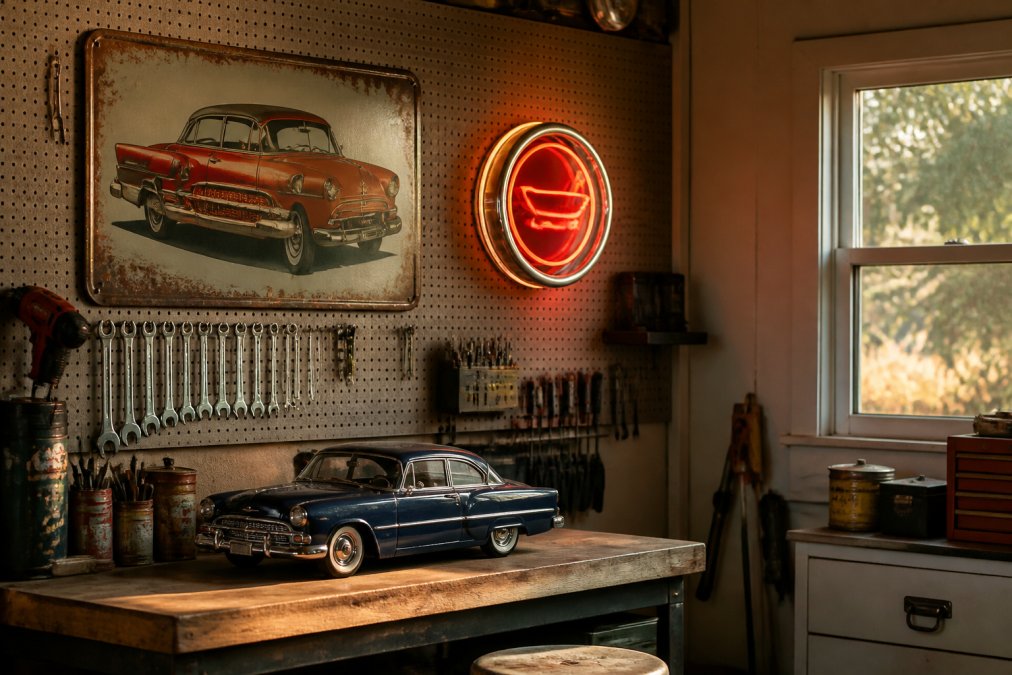
Metal Signs and Enamel Panels
Metal tin signs and enamel panels are the workhorses of garage decor. They're flat, light, and easy to hang, and their weathered patina suits an industrial or rustic aesthetic perfectly. Hang them at eye level in a horizontal row rather than scattering them randomly. The Dulux colour and design guidance is worth consulting on how warm metallics interact with your wall colour before you commit.
Neon and Illuminated Pieces
Neon and illuminated pieces become the focal point of a small garage, so use them sparingly. One strong illuminated piece above a workbench or bar area draws the eye and makes the whole space feel intentional. The Hot Rod Neon Light ($50.00) is exactly the kind of single statement piece that anchors a wall without crowding it.

Small Garage Organisation Tips for Collectors
Most organisation advice for garages is written for workshops, not for collectors who still park a car inside. That is the gap this section fills: how to store and display a collection in a single-bay garage without losing the vehicle, the walkway, or your sanity.
Work Out Your Real Clearance First
Before buying a single hook or rack, measure the usable envelope. A typical single garage in Australia is around 3.0m wide by 6.0m deep, but internal dimensions vary, so measure yours. From the parked car, allow:
- At least 600mm beside the vehicle at door height so doors open fully
- Around 900mm of walkway where you carry shopping or wheel a bin
- Full clearance at the rear for the roller door track and its travel
Match the Storage Type to the Wall Zone
Not every wall can take the same treatment. A simple zoning approach:
- Side walls above door height: pegboard and shallow rails for tools, small signs, and hanging pieces. Keep pegboard panels to around 600mm x 1200mm so they sit between studs and stay manageable.
- Rear wall: the deepest storage goes here, because it is furthest from door swing. Overhead racks, a tall closed cabinet, or a full-height shelving unit work best against the back wall.
- Corners the car never reaches: freestanding display cabinets or a bar leaner, provided they clear the walkway.
- Ceiling zone: overhead racks for bulky, rarely used items such as spare wheels, camping gear, or seasonal decorations. Keep them clear of the roller door's path.
The Rotation Shelf Mechanism
The rotation shelf is the trick most collectors miss, and it is worth explaining properly. Instead of displaying everything at once, dedicate one visible shelf or cabinet top to a rotating selection. Cycle pieces monthly or seasonally. The mechanism works because your eye reads a small, changing display as curated, while a static wall of thirty items becomes visual noise you stop noticing.
- Install a pegboard panel above the workbench for tools and small hanging pieces
- Use wall-mounted rails for heavier items instead of freestanding shelves
- Keep one closed cabinet for the clutter you don't want on display
- Reserve a single "rotation shelf" for pieces you swap in and out seasonally
- Label overhead rack contents so you are not guessing what is up there
Keep One Empty Surface
A counter-intuitive rule that experienced collectors swear by: leave one bench or shelf completely empty. It gives you somewhere to set down a tool, a cup, or a new find without clearing space first, and it stops the garage from feeling like every surface is fighting for attention.
Lighting Vintage Decor in a Compact Garage
Lighting vintage decor in a compact garage is a design decision, not an afterthought. Poor lighting flattens patina and makes even good pieces look dull. Layer your lighting: bright overhead LEDs for working, and warmer accent lights aimed at your display walls for atmosphere.
Safety and Practical Rules for Garage Decor
Safety comes before styling, and this is the part most decor guides skip entirely. A garage stores fuel, tools, and often a hot vehicle, so anything you hang or mount has to survive heat, vibration, and occasional knocks.
- Keep all decor clear of exhaust paths and at least 1 metre from any heat source
- Mount everything into studs or use appropriate masonry anchors, never adhesive hooks
- Don't block the fire door, extinguisher, or electrical panel with any display
- Store flammable materials away from illuminated pieces, which generate heat
- Check local requirements for smoke alarms and any fixed electrical work, which must be done by a licensed electrician
Build a Focal Point That Ties the Whole Space Together
A focal point gives a small garage a purpose and stops it feeling like a random collection. But a focal point is not just "the biggest thing on the wall", it is a deliberate arrangement of scale, light, and theme that tells your eye where to land.
Choose the Wall You See First
Stand at the open roller door and look in. The wall your eye hits first is your focal wall. In most single-bay garages that is the rear wall, because it faces the entrance. If your garage is deeper than it is wide, the rear wall is almost always the right choice.
The Three-Element Rule
A focal point that works usually combines three elements:
- One dominant piece, a large metal sign, a single illuminated sign, or a substantial wall hanging. This sets the scale.
- Two or three supporting pieces, smaller themed items arranged around or below the dominant piece. These create rhythm without competing.
- One light source aimed at it, a picture light, a small spotlight, or the glow of the illuminated piece itself. Light is what makes the focal point read as intentional rather than accidental.
If you have more than three supporting pieces, you have a collection wall, not a focal point. Both can work, but they are different design decisions and should not be mixed on the same wall.
Scale, Not Quantity
The most common mistake in a small garage is treating "more" as "better". A single 900mm-wide sign has more presence than five 300mm signs, because scale reads from across the room while detail only reads up close. In a compact space, you are almost always designing for the view from the doorway, not the view from 500mm away.
Build the Palette Around the Focal Piece
Once your centrepiece is chosen, pull two or three colours from it and repeat them subtly elsewhere, a cushion on a bench, a painted shelf edge, a small sign in the same tone. This is what makes a garage feel designed rather than assembled. Warm metallics, deep reds, cream, and black are the classic vintage garage palette, and they sit comfortably against most wall colours.
| Goal | Best Approach | Why It Works |
|---|---|---|
| Save floor space | Wall-mounted metal signs | Zero footprint, high impact |
| Add atmosphere | Single neon or illuminated piece | Draws the eye, sets the mood |
| Show a themed collection | Grouped shadow boxes and shallow shelves | Tells a story, stays tidy |
| Keep the space usable | Vertical storage and pegboard | Frees walkways and parking |
The Doorway Test
Once your focal point is set, step back and look at the room from the doorway. If your eye lands on one clear feature and the rest recedes, you have got it right. If everything shouts at once, remove two pieces and try again. Most collectors find they need to remove more than they add to get this right, and that is normal, restraint is the skill.
Frequently Asked Questions
How do you display vintage memorabilia in a small garage without cluttering it?
Pick one wall as your display zone and keep it to three to five pieces. Mount items at eye level using a consistent grid or a single horizontal line. Group small collectibles on one shelf rather than scattering them across several surfaces. Rotate pieces seasonally so the wall stays fresh without adding more. If a piece has no clear home, store it rather than squeezing it in.
What lighting works best for highlighting vintage garage decor?
Warm LED spotlights in the 2700K to 3000K range bring out the patina on metal signs and aged timber without washing out colours. Aim two or three adjustable spots at your focal wall rather than lighting the whole room. Add a small neon or illuminated piece as its own light source so it glows after dark. Avoid cool white fluorescents, which make vintage finishes look flat and grey.
Are there specific vintage items that work best in small garages?
Flat, wall-mounted pieces give you the most impact per square centimetre. Metal tin signs, enamel plates, and wall hangings such as a Route 66 or Mopar design sit flush against the wall and free up floor space. Neon lights add colour without taking up room. For bench surfaces, stick to one or two small items like a classic car model or an antique tool, and keep the rest stored.
How can I use vertical space to style vintage items in a garage?
Run a pegboard or slatwall panel across one wall and hang tools, signs, and small collectibles on it. Add a high shelf near the ceiling for items you display but rarely touch. Stack vintage crates or suitcases vertically in a corner to create height. Keep the lowest 40 centimetres clear so you can still park and open car doors without knocking anything over.