
Table of Contents
- Why Vintage Decor Belongs in Your Man Cave
- Retro Man Cave Wall Art That Sets the Tone
- Vintage Neon Signs for Home Bars and Dens
- Collectible Man Cave Items That Start Conversations
- Styling a Small Man Cave Without the Clutter
- Budget-Friendly Restoration and Sourcing Tips
- Frequently Asked Questions
Last Updated: September 10, 2026
Why Vintage Decor Belongs in Your Man Cave
Vintage decor for man caves works because it transforms a spare room into a story. A tin sign, a neon tube, a die-cast Chevy: each piece signals a specific era and taste, creating the difference between a decorated room and a collected one.
Buyers are not hunting for furniture; they are hunting for character, something mass-produced homewares cannot supply. According to the National Archives of Australia's collection guides, mid-century advertising and industrial objects are among the most requested categories for private collectors, indicating demand is cultural, not just decorative.
The trick is knowing which pieces earn their wall space. Below: the categories worth collecting, what they cost, and how to style them without turning your den into a junk shop.
Retro Man Cave Wall Art That Sets the Tone
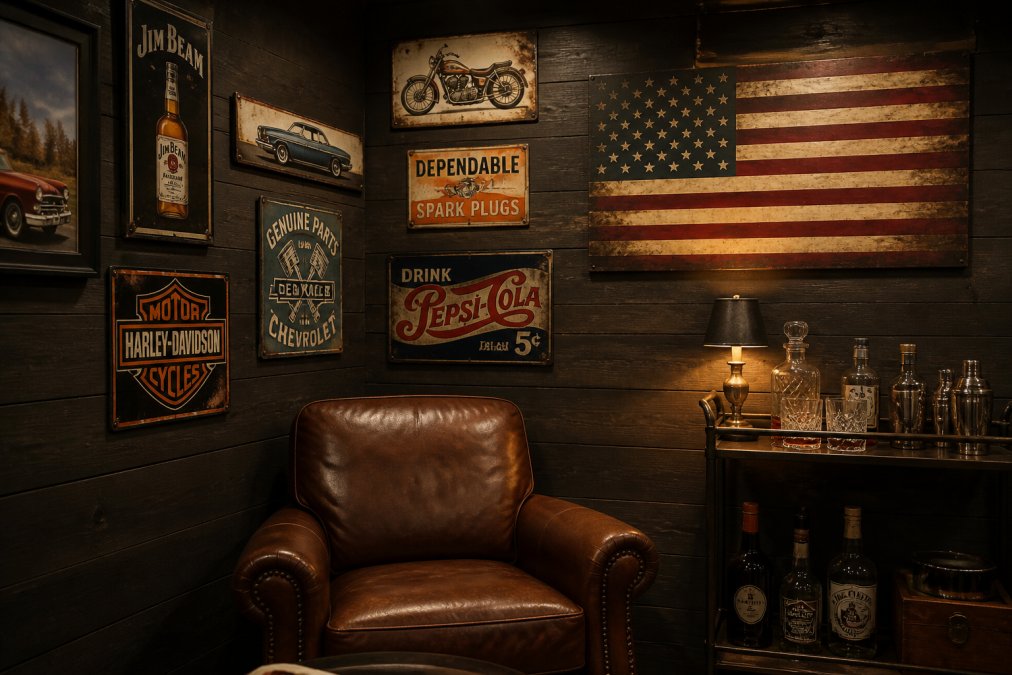
Retro man cave wall art is the fastest way to establish a theme because it covers large surface areas at a relatively low cost. Two or three well-chosen pieces significantly outperform a dozen small trinkets scattered across shelves.
Start with a hero piece, then build outwards. A Route 66 Wall Hanging at $50 or a Ford Wall Hanging at $50 provides an instant focal point in red, white, and chrome, and both sit comfortably alongside timber panelling or exposed brick.
Tin Signs and Metal Wall Hangings
Tin and metal signs are the workhorses of any vintage setup: lightweight, flat against a wall, and they survive decades without fading. A common mistake is arranging them in a perfect grid; offset them instead, mixing portrait and landscape formats, and leave breathing room so the wall reads as curated rather than crowded.
A Vintage Style Route 66 Case at $40 is a good entry point if you want something with depth rather than a flat panel. For a statement wall, pair metal signage with a Vintage Coca Cola Clock at $100 and let the clock anchor the centre.
Vintage Neon Signs for Home Bars and Dens
Vintage neon signs for home are the single most effective way to alter a room's feel after dark, casting coloured light across the ceiling and walls. This transforms a den that appears flat by day into one with atmosphere at night.
The Hot Rod Neon Light at $50 is compact, easy to mount above a bar or workbench, and it delivers that classic garage-sign glow without requiring a dedicated power circuit.

Collectible Man Cave Items That Start Conversations
Collectible man cave items do something wall art cannot: they invite people to touch, ask, and reminisce, drawing guests' attention within minutes.
Vending Machines and Slot Machines
A Vintage Coke Vending Machine at $500 or a Vintage Pepsi Vending Machine at $650 can turn a corner into an event. Both are pick-up only and require floor space rather than a shelf. The Vintage Mills Jackpot Slot Machine at $500 is a mechanical conversation piece that, unlike most decor, actually does something.

| Item |
|---|
| --- |
| Vintage Mills Jackpot Slot Machine |
| Vintage Coke Vending Machine |
| Vintage Pepsi Vending Machine |
| Harley Davidson Dual Gas Pump |
Automotive and Garage Memorabilia
Automotive memorabilia forms the backbone of the genre. The Harley Davidson Dual Gas Pump at $2,000 is the top-of-the-range item and functions like sculpture: it requires clearance around it, a solid floor, and ideally a spotlight.
For a smaller budget, a Vintage Record Player at $50 adds sound as well as looks and pairs naturally with a bar cart. Group pieces by era rather than type: a 1950s Chevy sign next to a 1970s slot machine reads as a collection, while the same two pieces on opposite walls read as clutter.
Styling a Small Man Cave Without the Clutter
Most vintage decor content assumes you have a double garage to fill. If your man cave is a spare bedroom, converted laundry, balcony nook, or a single-car garage that still fits a car, the rules change completely. Small caves are the most underserved setup in this category.
The governing principle: in a small room, every piece must justify its footprint. Favour wall-mounted and vertical pieces over floor-standing ones, and treat the ceiling as usable real estate.
Work Out Your Real Usable Area First
Before you buy anything, measure the room and subtract the circulation zone. A den under approximately 8 square metres typically loses roughly a third of its floor space to door swing, walkways, and seating. What remains is your display footprint.
A quick way to plan it:
- Measure length and width, then subtract 90cm along any wall with a door
- Mark the seating position; you need roughly 60cm of clear space in front of it
- Note ceiling height; anything above 2.4m can accommodate a hanging piece
- Identify one wall that gets no direct sunlight, as this is where neon and clocks look best
Go Vertical Before You Go Outward
Wall-mounted pieces are the small-cave cheat code because they consume zero floor area. Flat tin signs and metal wall hangings sit within a few centimetres of the wall, allowing a narrow den to still carry a dense, curated look without feeling blocked in.
Stack vertically rather than spreading horizontally. A tall, narrow arrangement—a large sign at eye level, a clock above it, a small neon to the side—reads as a deliberate column and leaves the rest of the wall clear. Conversely, a wide, low arrangement competes with the furniture line and reads as clutter.
Choose Slim-Profile Pieces
Not all vintage decor is space-neutral. As a rough guide:
| Piece type |
|---|
| --- |
| Flat tin sign or wall hanging |
| Framed clock |
| Neon sign |
| Bar cart |
| Vending machine or gas pump |
If your room is tight, the bottom two rows are the ones to avoid. A Vintage Coke Vending Machine at $500 is a fantastic centrepiece in a large cave and a space disaster in a small one.

Use the Ceiling and Corners
Corners are dead space in most small dens. A slim corner shelf, a high wall-mounted clock, or a neon sign angled across the corner reclaims area that furniture cannot use. A lightweight sign hung from the ceiling above a bar or seating zone adds interest without touching the floor.
Keep One Wall and One Surface Bare
The most common mistake in a small cave is filling every available plane. Once walls, shelves, and floor are all occupied, pieces stop reading as collectible and start reading as storage. Leaving one wall clear and one surface empty gives the eye a break and makes what you display feel intentional.
Small-Cave Themes That Work
Because you cannot rely on volume, lean on cohesion. Pick one era or subject and stay within it: a single-wall 'petroliana' theme with a couple of tin signs, a clock, and a small neon reads as a complete collection, which a mixed bag never will. Grouping by era rather than type separates a themed small cave from a random assortment.
Budget-Friendly Restoration and Sourcing Tips
Restoration is where you get the most value for the least money: a dull, dusty sign that cleans up well costs a fraction of a mint-condition equivalent, and the work is part of the appeal. But the real savings come from sourcing well, knowing where to look, what to pay, and how to spot a reproduction before you hand over cash.
Where to Source Vintage Pieces
The best-value finds rarely come from retail. The cheapest authentic pieces turn up through channels that require legwork:
- Op shops and charity stores: Inconsistent, but the occasional tin sign or barware piece slips through underpriced because staff cannot date it.
- Garage sales and clearing sales: Rural and outer-suburban clearing sales are where workshop and shed contents surface, often in bulk.
- Marketplaces and online classifieds: Good for volume, but you are competing with other collectors, so know your ceiling price before you bid.
- Swap meets and car club events: The strongest channel for automotive memorabilia, because sellers are enthusiasts who can usually tell you a piece's history.
- Estate and deceased-estate sales: Genuine mid-century pieces most often appear here, usually with provenance attached.
Buying in bulk from a clearing sale and on-selling the pieces you do not want is one of the most reliable ways to fund the pieces you do.
How to Spot a Reproduction
Reproductions are common, and the giveaway is almost always the finish. Authentic pieces show uneven wear, faded inks, and imperfect edges from real ageing; reproductions look uniformly new, with crisp edges and consistent colour across the surface.
Other tells to check:
- Weight: Genuine enamel and heavy-gauge tin feel dense; thin reproductions feel light and tinny.
- Edges: Original pieces usually have rolled or folded edges from manufacturing, not clean cut lines.
- Mounting holes: Old signs were nailed up, so original holes are worn and slightly oval, not perfectly round.
- Printing method: Older pieces often show slight registration misalignment between colours, which reproductions rarely replicate.
- Back surface: The reverse often tells the truth: rust, old paint, and uneven patina are hard to fake convincingly.
Ask about provenance before you commit, and buy from sellers who can tell you where a piece came from. A vague answer is a warning sign.
A Gentle Restoration Sequence
Start with the gentlest method and escalate only if needed:
- Dust with a dry, soft brush before anything wet touches the surface.
- Test any cleaner on a hidden corner first, never on the face.
- Use mild soap and water for metal; avoid solvents on painted tin.
- Leave patina intact on signage; cleaning to bare metal destroys value.
- Check neon transformers before powering up old tubes.
- Store spare parts and original fittings with the piece.
For neon specifically, never power up an old tube before inspecting the transformer; a failed transformer is the most common cause of a dead sign, and replacing one is far cheaper than rewinding the tube. If the tube is cracked or the gas has escaped, that is a specialist job, not DIY.
For timber pieces, bar tops, stools, and crates, the rule is the opposite of metal. Light sanding and a fresh oil or wax finish can lift a tired piece without erasing its history, because timber patina sits in the grain rather than on the surface.
What Restoration Actually Costs
Budget for consumables rather than tools. Soft brushes, mild soap, fine-grade wire wool, a replacement transformer, and a small tin of furniture wax cover most jobs for well under the price of a single mid-range sign. The expensive mistakes are power tools and harsh solvents that permanently damage a piece worth more untouched.
If a piece needs structural repair—a cracked neon tube, a seized vending mechanism, a broken clock movement—it is usually worth paying a specialist. Those repairs protect value, whereas amateur fixes tend to reduce it.
Frequently Asked Questions
What are some good decorations for a man cave?
Vintage signs, neon lights, automotive memorabilia, and retro bar accessories work well together. Start with one focal piece like a neon sign or a large wall hanging, then layer smaller items around it. Group similar themes, such as Route 66 signs with classic car models, to keep the space cohesive. Avoid filling every surface at once; leave breathing room so each piece stands out.
How do I style a vintage-themed man cave on a budget?
Focus on one or two statement pieces and build around them with affordable accents. Retro wall art and tin signs start around $40-$50, and vintage-style clocks or record players are similarly priced. Look for pieces that need minor cleaning or repair, since restoration is part of the appeal. Spacing items well makes a small collection look intentional rather than sparse.
Are man caves still popular?
Yes, man caves remain a popular way to create a personal retreat at home, especially for collectors and hobbyists. The trend has shifted toward curated, themed spaces rather than cluttered rooms. Vintage decor for man caves often centres on Americana, automotive history, and classic bar culture, giving these spaces a nostalgic character that modern furniture cannot replicate.
How do I know if vintage decor is authentic or a reproduction?
Check for wear patterns, manufacturer marks, and material quality. Authentic pieces from the early to mid-1900s typically show consistent ageing, while reproductions often look too clean or use modern materials. Ask the seller about provenance and whether an item is original or a vintage-style reproduction. Honest sellers will state this clearly, and reproductions can still look great if priced fairly.
What is the best way to display collectible man cave items?
Group items by theme and vary heights to create visual interest. Use shelving for smaller collectibles, wall mounts for signs and hangings, and floor space for larger pieces like vending machines or gas pumps. Keep walkways clear and avoid overcrowding shelves. Rotating pieces seasonally keeps the space feeling fresh without buying more.
Building a den that looks collected rather than assembled takes time, and the pieces that carry the most weight are rarely the cheapest impulse buys. Lost America Cool Classic Collectables curates vintage-inspired decor and classic memorabilia precisely for this kind of space, from neon lights and metal wall hangings to vending machines and automotive centrepieces. Browse the collection, pick your hero piece first, and build the room around it.