
Table of Contents
- Assessing Your Vintage Coca-Cola Tin Before Cleaning
- Safe Cleaners for Vintage Metal: What Works and What to Avoid
- How to Clean Vintage Advertising Tins: Step-by-Step
- Cleaning Rusty Vintage Tins Without Damaging the Finish
- Cleaning the Inside of Old Tins and Bottles
- How to Store Vintage Coca-Cola Collectibles After Cleaning
- Conclusion: Preserving Your Coca-Cola Tin for the Long Term
- Frequently Asked Questions
Last Updated: October 9, 2026
Assessing Your Vintage Coca-Cola Tin Before Cleaning
The best way to clean vintage coca cola tins starts with looking, not cleaning. At Lost America Cool Classic Collectables, we've handled enough mid-century advertising tins to know the wrong cleaner can strip more value in ten seconds than fifty years of dust ever did.

Vintage advertising tins are lithographed steel printed with coloured inks and a thin protective coating. That coating is fragile: once it lifts, the paint goes with it. So assess before you touch anything.
Identifying Surface Type and Condition
Check the tin in bright, natural light. Look for these clues:
- Shiny, smooth areas mean the original finish is intact. Treat these gently.
- Dull, chalky patches suggest the coating has worn thin.
- Flaking or lifting edges mean the paint is already loose.
- Rust shows as orange-brown speckling, often along seams and rims.
Run your fingertip along a seam. If paint flakes off, stop. That tin needs a conservator, not a cleaning session. For deeper guidance on caring for metal objects, the Canadian Conservation Institute's notes on metals are a solid reference.
When to Leave Patina and Rust Alone
Not every tin should be cleaned.
Patina is the soft, aged surface that develops over decades, and collectors prize it. Strip it off and a genuine 1950s piece looks like a reproduction.
Leave the tin alone if:
- The rust is light surface bloom and the tin is stable
- The graphics are already fragile or lifting
- The piece is rare, signed, or part of a matched set
- You're unsure whether the finish is original
Safe Cleaners for Vintage Metal: What Works and What to Avoid
Safe cleaners for vintage metal lift dirt without attacking paint, coating, or bare steel: mild, pH-neutral options applied sparingly.
What we reach for first:
- Soft microfibre cloths for dry dusting
- Warm water with a drop of mild dish soap for grime
- A soft bristle brush for seams and embossed lettering
- Cotton swabs for tight corners
What to avoid completely:
- Abrasive powders and scouring pads
- Bleach, ammonia, and heavy-duty degreasers
- Oven cleaner or anything caustic
- Prolonged soaking in water of any kind
That last one surprises people. Toothpaste is a mild abrasive, and on a lithographed tin it dulls the printed design. It works on bare metal and some glass, but it has no place on vintage advertising tins. The Smithsonian Museum Conservation Institute guidance on caring for metal artefacts makes the same point about abrasive pastes.
How to Clean Vintage Advertising Tins: Step-by-Step
The best way to clean vintage coca cola tins is a slow, dry-first process: remove the least you can, in the gentlest way possible, and stop the moment the tin looks better.
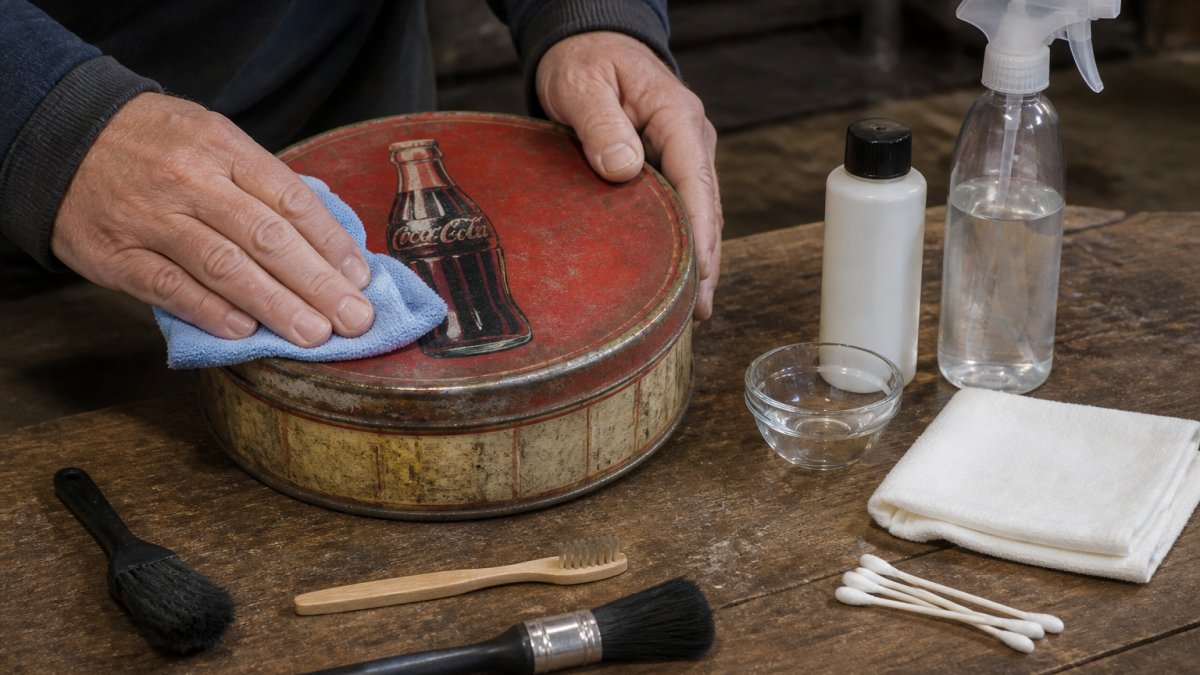
Step 1: Dust and Dry Debris Removal
Start dry. Always.
Wipe with the grain of the printed design, not against it. For seams and embossed areas, use a soft bristle brush.
- Never press hard. Let the cloth do the work.
- Shake dust outside, not over the tin.
- Use a cotton swab for lettering and tight corners.
- Change cloths as they pick up dirt.
Expected result: loose dust and surface grime gone, with no change to the finish.
Step 2: Targeted Stain Removal and Gentle Wiping
Now tackle stains, one at a time.
Dampen a microfibre corner with warm water and a drop of mild soap, wring until barely wet, and wipe only the stain. Rinse with clean water. For light rust spotting, dab with a vinegar-dipped swab, don't scrub, and wipe dry straight away.
- Work in small sections, not the whole tin at once
- Never let water sit on the surface
- Never submerge the tin
- Stop if the cloth shows colour from the print
Expected result: stains lifted, printed design still sharp.
Step 3: Drying and Post-Clean Inspection
Dry the tin immediately with a clean, soft cloth, then air it an hour in a dry room away from direct sun.
Once dry, check your work:
- Any dulling or colour lift? That area was over-cleaned.
- Any new rust bloom? Moisture got left behind.
- Any loose flakes? Set those pieces aside.
Expected result: a dry, stable tin with its graphics intact.
Cleaning Rusty Vintage Tins Without Damaging the Finish
Cleaning rusty vintage tins is where most people ruin a good piece. Work out what kind of rust you're looking at first, treatment and risk differ.
- Surface bloom is a thin, powdery orange film sitting on top of the coating. It often wipes away dry and has not eaten into the steel.
- Active corrosion is darker, rougher, and feels slightly raised. It is still progressing and will spread if moisture stays present.
- Pitted corrosion has broken through the coating and left small craters in the steel. The metal is already lost. Cleaning cannot restore it, only stabilise it.
A simple test: press a dry cotton swab onto the spot. If orange powder transfers and the surface underneath feels smooth, it is bloom. If the surface feels gritty or the swab snags, corrosion has reached the steel.
Why Each Method Behaves the Way It Does
Lithographed tins are printed steel with a thin coating over the ink. Anything that dissolves or abrades that coating exposes the ink, and the ink carries the value.
- Dry brush and cloth removes loose bloom without touching the coating. No chemistry, no risk.
- Vinegar dab on a swab works because acetic acid dissolves iron oxide. The same acid will dull a lithographed coating and can lift ink if left on, so it must be dabbed, not scrubbed, and wiped dry within seconds.
- Fine bronze wool, dry is softer than steel wool and less likely to scratch bare metal, but it still abrades. On a coated surface it will dull the sheen and can drag across printed edges.
- Chemical rust removers are usually phosphoric or oxalic acid based. They convert or dissolve rust quickly and will strip paint, coating, and ink just as quickly.
| Method | Best For | Mechanism | Risk to Finish |
|---|---|---|---|
| Dry brush and cloth | Light surface bloom | Mechanical lift only | Very low |
| Vinegar dab on a swab | Small rust spots on bare metal | Mild acid dissolves oxide | Low if wiped dry within seconds |
| Fine bronze wool, dry | Flaking rust on unpainted metal | Gentle abrasion | Medium, dulls coating and can drag ink |
| Chemical rust removers | Heavy corrosion on bare steel | Acid converts or dissolves oxide | High, strips paint and coating |
| Electrolysis | Serious restoration projects | Electrochemical reversal | High, removes all non-steel material |
For most collectible tins, stop at the first two rows. Anything beyond that is a restoration job, not a cleaning job.
When Not to Remove Rust at All
On a collectible tin, stable rust is often part of the object's history, and removing it can cost more value than leaving it.
Leave the rust alone when:
- The corrosion is dry, stable, and not spreading
- It sits on or near the printed graphics
- The tin is rare, part of a matched set, or has provenance
- The coating around the rust is already lifting
Among collectors, stable age wear reads as authentic, while a scrubbed-out patch reads as damage.
Unsure whether rust is stable or active? Store the tin in a dry, stable spot for a few weeks and check again.
Cleaning the Inside of Old Tins and Bottles
The inside of an old tin is usually bare, uncoated steel, which rusts faster and has no printed design to protect.
For inside surfaces:
- Wipe with a barely damp cloth, then dry straight away
- Use a soft brush for loose rust flakes
- Skip vinegar soaks entirely
- Never fill the tin with water
Glass bottles, including old Coca-Cola bottles, are non-porous: a warm water soak with a drop of mild soap is fine. Use a bottle brush, rinse well, and dry upside down on a rack. Plastic bottles scratch easily, so use a soft sponge only.
How to Store Vintage Coca-Cola Collectibles After Cleaning
How to store vintage Coca-Cola collectibles matters as much as how you clean them. A clean tin stored badly will rust again within a season, because moisture in the air condenses on cool metal. The goal is not to seal the tin away, but to keep the surrounding air dry and stable.
Choosing the Right Space
- A dry room with stable temperature is the baseline. Internal rooms fluctuate less than garages, sheds, or attics.
- Avoid anywhere damp. Laundries, bathrooms, basements, and unventilated cupboards hold moisture.
- Keep pieces out of direct sunlight. UV light fades inks and makes old coatings brittle.
- Avoid kitchens. Cooking releases steam and grease that settle on surfaces.
Simple check: if a cold glass of water forms condensation within minutes in a room, that room is too humid for long-term tin storage.
Handling and Positioning
- Stand tins upright. Lying a tin on its side stresses seams and rims, the first places to corrode.
- Don't stack. Stacking scratches printed surfaces and traps moisture.
- If you must stack, use acid-free tissue between items, and only stack similar sizes and weights.
- Handle with clean, dry hands or cotton gloves. Skin oils and salts etch coatings over time.
Materials That Help and Materials That Hurt
- Acid-free tissue and boxes are safe for long-term contact with printed surfaces.
- Silica gel sachets buffer humidity in a display cabinet, but need recharging regularly.
- Ordinary cardboard and newspaper are acidic and stain or degrade coatings. Avoid them.
- Bubble wrap and cling film trap moisture and leave marks. Use acid-free tissue instead.
- Rubber bands and adhesive tape leave residues that are hard to remove.
A Monitoring Routine
Check stored tins twice a year, and after unusually humid weather.
- Look for new rust spots, especially along seams, rims, and the base.
- Check for lifting or flaking coating, which signals the environment is too dry or variable.
- Check for dulling or colour shift, which signals light exposure.
- Note changes and adjust the storage location, not the tin.
For display, a shelf away from windows works well. If you're building a themed display, our Coca Cola Popcorn Tin shows the kind of clean, well-kept piece that holds its colour and graphics over time. It's priced at $50.00.
Conclusion: Preserving Your Coca-Cola Tin for the Long Term
The real challenge with vintage tins isn't cleaning, it's restraint. Every scrub, soak, and shortcut removes history you can't put back.
If you'd rather start with a piece already in good condition, browse the curated range at Lost America Cool Classic Collectables. Our vintage-inspired collectibles and classic Americana are chosen for display quality and lasting charm. Shop Now and find a piece worth keeping for the next fifty years.
Frequently Asked Questions
How do you clean a vintage Coca-Cola tin without damaging it?
Start by dusting with a soft brush, then wipe with a barely damp microfibre cloth. Avoid soaking, abrasive pads, and acidic cleaners. Test any cleaner on a hidden area first. For light grime, a dry soft cloth is often enough. If the tin has flaking paint or active rust, stop and consult a conservator before proceeding.
Can you wash a vintage Coca-Cola tin with soap and water?
You can use a small amount of mild dish soap diluted in water, but wring the cloth nearly dry before wiping. Never submerge the tin or let water sit on the surface. Rinse by wiping with a clean damp cloth, then dry immediately with a soft towel. Prolonged moisture can lift paint and encourage rust.
Should you remove rust from a vintage Coca-Cola tin?
Only remove loose, active rust that is flaking or spreading. Stable surface rust and patina often add character and value. Aggressive rust removal can strip original paint and graphics. For valuable or rare tins, consult a conservator.
How should vintage Coca-Cola tins be stored after cleaning?
Store tins in a dry, climate-controlled space away from direct sunlight and humidity. Use acid-free tissue or cotton gloves when handling. Keep them upright and avoid stacking heavy items on top. A display cabinet with silica gel packets can help control moisture. Avoid attics, garages, and damp cupboards where rust and paint damage accelerate.