
Table of Contents
- Start With the Basics: What Makes a Sign Authentic?
- How to Spot Reproduction Enamel Signs
- Reading Coca-Cola Sign Maker Marks
- Material Analysis: Metal, Enamel, Cardboard, and Plastic
- Warning Signs of Modern Imports and Fantasy Pieces
- Chemical and Magnet Testing for the Serious Collector
- Vintage Coca-Cola Sign Value Guide
- Conclusion: Building a Collection You Can Trust
- Frequently Asked Questions
Last Updated: October 4, 2026
Start With the Basics: What Makes a Sign Authentic?
A genuine vintage Coca-Cola sign is one made in the era it claims to be from, using the materials and methods of that time.
At Lost America Cool Classic Collectables, we offer a curated selection of vintage-inspired items and classic memorabilia. Buyers often want to know what separates a real sign from a reproduction.

Real signs show patina, a natural surface change built up over decades. They also carry manufacturing marks from the original maker.
Below, we break down exactly how to tell the difference, from maker marks to magnet tests.
How to Spot Reproduction Enamel Signs
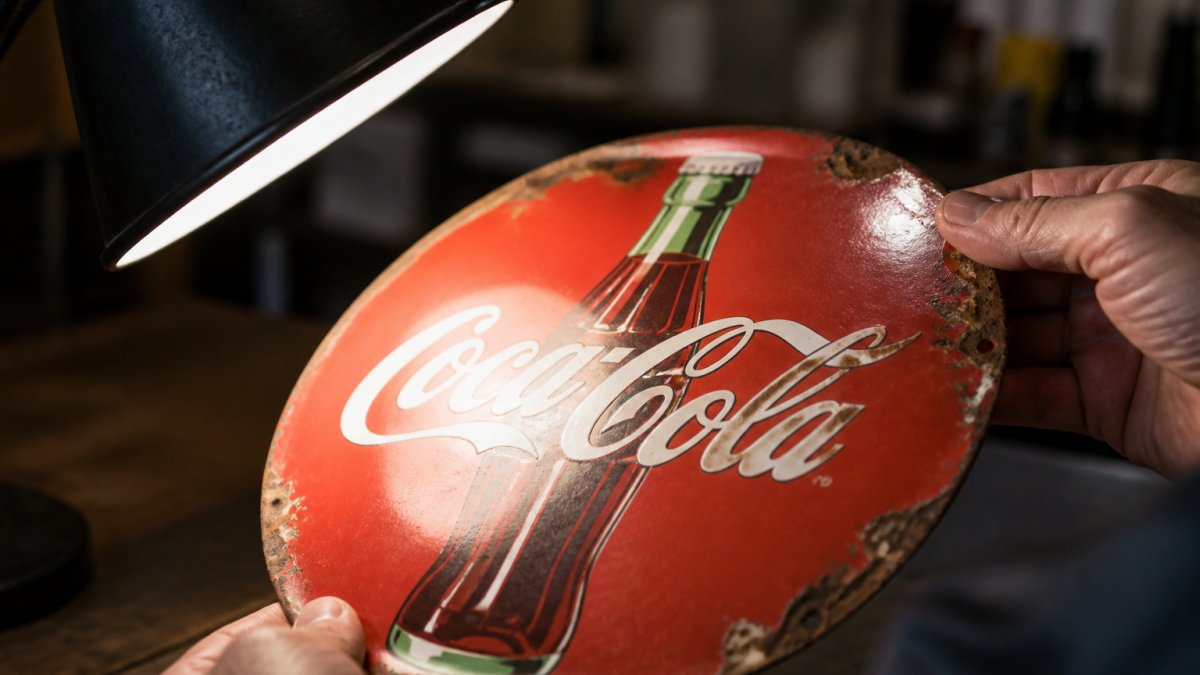
Reproduction enamel signs usually fail on surface texture. Real enamel was fired at high heat, so the glass coating sits flush with the metal.
Look closely at the edges. Original enamel chips in sharp, glass-like flakes. Cheap reproductions chip in soft, powdery patches.
Check the paint adhesion too. On genuine signs, the colour sits under the glass layer. On fakes, the paint often sits on top and scratches off with a fingernail.
Other quick tells:
- Halftone dots visible under a magnifying glass (real signs used solid colour blocks)
- Typography that is slightly off, with wrong letter spacing
- Grommets that look machine-pressed rather than hand-set
- Mounting holes drilled after printing instead of during production
Reading Coca-Cola Sign Maker Marks
Coca-Cola sign maker marks are the fastest way to date a piece. Real signs usually carry a maker name, a date, or a code stamped or printed somewhere on the surface.
Common marks appear on the bottom edge or the back. Look for the maker's name, a plant code, or a small date stamp.
Fakes often get this wrong. The typography is too modern, the spacing is off, or the mark is missing entirely.
A common mistake is trusting a printed date on its own. Anyone can print "1935" on a sheet of tin.
Material Analysis: Metal, Enamel, Cardboard, and Plastic
Material composition is where most fakes fall apart. Real vintage signs were made from heavy metal gauge steel, fired enamel, or thick cardboard. Modern copies use thin tin, plastic, or coated paper.
Here is how the main materials compare:
| Material | Real Signs | Common Fakes |
|---|---|---|
| Steel | Heavy, 20-24 gauge, magnetic | Thin tin, light, flexes easily |
| Enamel | Fired glass coating, chips sharp | Painted or powder-coated, chips soft |
| Cardboard | Thick stock, aged yellowing | Thin card, bright white, no aging |
| Plastic | Rare before the 1960s | Common in modern reproductions |
Pick the sign up. Real steel feels dense. If it bends under light pressure, it is too thin to be original.
Oxidation is another clue. Real metal rusts in patterns that follow the grain. Fakes often show uniform, painted-on rust that looks the same across the whole surface.
Warning Signs of Modern Imports and Fantasy Pieces
A fantasy piece is a sign that never existed in the original era. It uses real branding but a design that was never produced. These are the hardest fakes to spot because the logo looks right.
Watch for these fake alert signals:
- Designs that copy modern advertising styles
- Colours that are too saturated or too bright
- Sizing that does not match any known original
- Screen printing where the original used lithography
- Rust that sits on top of the paint instead of under it
Modern imports often skip embossing entirely. Real signs from the early 1900s often had raised lettering or a raised border. If a sign claims to be from that era but sits perfectly flat, be suspicious.
The collector community shares known fantasy designs openly. Before you buy, check whether the design has ever been documented as a real production piece.
Vintage 1924 Coca-Cola Calender →
Chemical and Magnet Testing for the Serious Collector
Visual inspection gets you most of the way, but a few simple, non-destructive tests will separate a genuine piece from a clever reproduction. None of these require lab equipment, and none should damage a real sign if you work carefully.
The magnet test
Run a small, strong magnet across the back of the sign. Genuine signs made from steel, the standard for most Coca-Cola signage from the early 1900s through the 1960s, will attract it firmly. Aluminium, plastic, and most modern reproductions will not.
Interpret the result with care:
- Strong, even pull across the whole surface: consistent with steel.
- Pull only at the edges or around mounting holes: the sign may be steel with a non-magnetic coating, or a reproduction with a steel frame and a non-magnetic face.
- No pull at all: the sign is not steel. That does not automatically make it fake, some later originals used aluminium, but it does mean the material must match the era the sign claims to be from.
The acetone spot test
A cotton bud with a tiny amount of acetone, applied to an inconspicuous spot on the back edge only, will lift modern acrylic or enamel paint within seconds. Fired vitreous enamel, the glass-like coating on genuine early signs, will not budge.
Loupe analysis: the test most guides skip
This is where serious collectors separate themselves from casual buyers. A jeweller's loupe at 10x magnification reveals the printing method, and the printing method dates the sign.
- Halftone dots: Modern offset and digital printing builds images from a grid of tiny dots. Under a loupe, a reproduction will show a regular dot pattern in what should be a solid colour block. Genuine early signs used lithography, which lays down solid, continuous colour with no visible dot screen.
- Dot shape and angle: Even where halftones appear on later originals, the dot pattern is coarse and irregular. Modern reproductions show fine, uniform, machine-perfect dots.
- Edge of colour: Lithographed colour sits flush with the metal. Printed colour on a reproduction often shows a slight raised edge or a halo where ink has spread.
A common pattern is that a sign passes the magnet test and the acetone test but fails the loupe test, because the reproduction was printed on steel with a modern coating. The loupe is the tie-breaker.
Provenance: the paper trail test
Testing tells you what a sign is made of. Provenance tells you where it has been. For any sign offered at a serious price, ask for:
- Auction records or a dealer invoice showing the sign's history.
- Photographs of the sign in its original location, if any exist.
- A named dealer or collector who will confirm the chain of ownership.
A genuine piece often has a story that can be checked. A reproduction usually has a story that cannot. No verifiable trail, no premium price, that is a reasonable rule to hold to.
Vintage Coca-Cola Sign Value Guide
Value in this market is driven by four things, in roughly this order: rarity, condition, design demand, and provenance. Age on its own is the weakest signal, a clean 1950s sign routinely outsells a damaged 1920s piece.
What actually moves the price
- Rarity: Signs produced for a short campaign, a specific region, or a single retailer are scarcer than mass-produced national pieces. A design that appears in every collector's inventory is rarely rare, no matter how old it is.
- Condition: Original gloss, full colour, and no repainting matter more than a few decades of extra age. Repainting is the single biggest value killer, it destroys the original finish and the patina that proves authenticity.
- Design demand: Some graphics and slogans have a dedicated following. A sign with a strong, recognisable design will outperform a plainer piece from the same era.
- Provenance: A documented history, auction records, a known dealer, photographs of the sign in situ, supports a premium. An undocumented sign of identical condition sells for less.
The authentication checklist
Work through this before you commit to any purchase. Print it, or keep it on your phone.
- Maker mark present, name, plant code, or date stamp on the edge or back
- Date matches materials, the claimed year fits the metal, coating, and print method
- Magnet test passed, steel attracts a magnet; aluminium or plastic does not
- Acetone test passed, fired enamel resists acetone; modern paint lifts
- Loupe test passed, solid lithographic colour, not halftone dots
- Wear is natural, rust follows the metal grain, chips are sharp and glass-like
- No repainting, original finish intact, no overspray or brush marks
- Design is documented, the piece is a known production design, not a fantasy
- Provenance checkable, auction records, dealer invoice, or named prior owner
- Price is consistent, the asking price reflects condition and rarity, not wishful thinking
If a sign fails more than one of these, treat it as a reproduction regardless of what the seller claims.
Grading scale
- Mint: no chips, full colour, original gloss, no repairs.
- Excellent: minor edge wear, no repairs, strong colour.
- Good: visible chips or fading, still displayable, no repainting.
- Fair: heavy rust, repainting, or missing sections, display only, minimal collector value.
Condition drives price more than age. A sign graded Excellent will typically command a significant premium over the same design graded Good, and a Fair sign is a decor piece, not an investment.
A note on honest reproductions
Not every buyer wants the risk and cost of an authenticated original. If you want a genuine vintage feel without the authentication headache, our curated range includes a Vintage Coca Cola Clock and a Vintage 1924 Coca-Cola Calender, both priced at $100.00. These are sold as vintage-inspired pieces, not misrepresented originals, which is the honest way to buy in this market.

Conclusion: Building a Collection You Can Trust
The hardest part of collecting is trust. One bad buy can sour the whole hobby, and dealer fraud is real in this space.
At Lost America Cool Classic Collectables, we keep it simple. Every piece in our range is sold as what it is: vintage-inspired decor.
Our range covers classic Americana, from clocks and calendars to nostalgic collectables. Each piece is chosen to add character to a home bar, garage, or den without the authentication headache.
Get started with Lost America Cool Classic Collectables and build a collection you actually enjoy.
Frequently Asked Questions
How can I tell if a Coca-Cola sign is real?
Check the maker marks, material, and typography. Authentic signs have embossed or stamped maker marks, consistent font styles, and proper metal gauge. Reproduction enamel signs often have blurry lithography, incorrect colours, and modern mounting holes. Look for patina and oxidation that matches the sign's age, and avoid pieces with pristine surfaces that lack surface wear. A magnet test can help identify steel versus aluminium.
What are the common signs of a reproduction Coca-Cola sign?
Reproduction signs often have bright, uniform colours with no fading, sharp edges without distressing, and modern grommets or mounting holes. Typography may be slightly off, and halftone patterns are usually too perfect. Check for a lack of oxidation and rust patterns that would naturally occur over decades. If the price seems too good for a collector-grade piece, it is likely a fake.
How much are vintage Coca-Cola signs worth?
Value depends on age, condition, rarity, and material. Original enamel signs from the early 1900s can sell for hundreds to thousands of dollars, while cardboard or plastic signs from the 1970s are often under $100. Our vintage Coca-Cola calendars are priced at $100, and clocks range from $50 to $100. Always verify authenticity before paying premium prices, as reproductions have little resale value.
Do vintage Coca-Cola signs have specific maker marks?
Yes. Authentic signs often feature embossed or stamped maker marks from companies like Tennessee Enamel Manufacturing Company or American Art Works. These marks are usually located near the bottom edge or on the back. Reproductions may have no marks, incorrect marks, or printed marks that lack depth. Research known makers and compare typography and placement carefully.