
Table of Contents
- What the 2026 Americana Revival Actually Looks Like
- Earthy Palettes and Moody Tones: The 2026 Colour Story
- How to Date Vintage Americana Clothing and Textiles
- Sourcing Authentic Vintage Americana Collectibles Without Guesswork
- Styling Vintage Neon Signs in Homes, Garages and Dens
- Layering Modern and Historic Elements in Small Spaces
- Maintaining and Restoring Antique Americana for the Long Term
- Frequently Asked Questions
Last Updated: September 26, 2026
What the 2026 Americana Revival Actually Looks Like
Vintage Americana home decor trends 2026 have moved past the novelty phase. The look is now less about themed rooms and more about patina, authentic craftsmanship, and pieces that carry a story. At Lost America Cool Classic Collectables, we've watched collectors shift from "retro-looking" items to genuine heirloom quality pieces they can style, maintain, and pass on.
Earthy Palettes and Moody Tones: The 2026 Colour Story
The 2026 palette leans into warm neutrals, earthy palettes, and moody tones rather than bright primary colours. Terracotta, moss green, burnt orange, and deep navy dominate, anchored against aged timber, oxidised metal, and lime-washed or chalky finishes. What separates a considered room from a themed one is the ratio, not the colours.
The 60/30/10 Ratio That Keeps Earthy Palettes From Turning Muddy
A 60/30/10 split can be a useful guideline in vintage Americana interiors:
- 60% base, a warm neutral wall or large surface (bone, oatmeal, mushroom, aged parchment).
- 30% secondary, timber, leather, or a mid-tone textile (cognac, walnut, faded denim, olive).
- 10% accent, the saturated note: terracotta, burnt orange, deep navy, or a single oxidised brass or copper object.
Finish Matters More Than Hue in Older Homes
In period interiors, sheen does more work than the colour name on the tin:
- Chalky, matte, or lime-wash finishes soften uneven plaster and hide hairline cracks that a satin or gloss would throw into relief.
- Eggshell on trim gives durability without the plastic sheen that reads as a modern renovation.
- Avoid high-gloss on walls in rooms with vintage neon or warm filament lighting, the reflection doubles the light source and flattens the mood.
- Test patches on the actual wall, not on a card. Aged plaster, timber lining boards, and old undercoat shift a colour noticeably.
Why Colour Drenching Works in Older Homes
Colour drenching means painting walls, trim, and sometimes ceilings in closely related shades, often the same hue at two or three tint strengths. In historic home interiors with uneven plaster, awkward proportions, or a low ceiling, a single tonal wash hides flaws that contrasting trim would highlight and makes lived-in spaces feel deliberate.
Drenching works best when:
- The room gets limited natural light, a tonal wash stops the space fragmenting into dark corners.
- The ceiling is low or the cornice is heavy, pulling the ceiling into the wall colour lifts perceived height.
- The furniture is a mix of eras, one continuous background lets disparate pieces read as a collection.
Where the Palette Meets the Objects
The colour story only lands when palette and collection agree. A deep navy wall makes aged brass and vintage neon glow warmer. A moss green study suits dark timber, leather-bound books, and oxidised copper. Keep a terracotta or burnt orange accent to a single plane, one wall, one alcove, one chimney breast, so the vintage pieces stay the focus.
How to Date Vintage Americana Clothing and Textiles
Dating vintage Americana clothing and textiles comes down to three checks: labels, construction, and materials. A garment's tag, stitching, and fibre content usually narrow the era faster than any style guide.
Work through these in order:
- Check the label. Union-made tags, care instructions, and sizing conventions changed across decades. A care label with synthetic fibre content generally points later than one without.
- Inspect the stitching. Early machine stitching is often uneven and single-stitched at stress points. Later mass production introduced overlocking and consistent zigzag finishing.
- Test the fabric. Natural fibres like cotton, wool, and linen dominate earlier pieces. Blended synthetics appear more frequently from the mid-20th century onward.
- Look at fasteners. Metal zippers, button materials, and hook-and-eye styles all shifted over time.
- Compare against reference collections. Museum textile archives and university costume collections are reliable comparison points.
Sourcing Authentic Vintage Americana Collectibles Without Guesswork
Authentic vintage Americana collectibles share three traits: consistent wear patterns, period-correct materials, and traceable provenance. Reproductions usually fail at least one, often all three.
What Reproductions Get Wrong
Reproductions look too clean. Genuine pieces show uneven fading, small repairs, and patina that develops only with age. A reproduction's "aged" finish is uniform, applied across the whole surface rather than where hands and light would touch it.
Other tells to check:
- Screws and fasteners that use modern thread types
- Paint that sits flat with no crazing or micro-cracking
- Weight that feels lighter than a period equivalent
Styling Vintage Neon Signs in Homes, Garages and Dens
Styling vintage neon signs works best when the sign is the room's single light source, not one of several competing fixtures. Neon reads best against a dark, matte wall where the glow carries.
Placement rules that hold up in practice:
- Mount at eye level or slightly above; too high and the glow washes out
- Keep at least 30cm of clear wall around the sign
- Avoid glossy paint behind neon; it reflects and dulls the effect
- Pair with warm, low-level lighting elsewhere in the room
Layering Modern and Historic Elements in Small Spaces
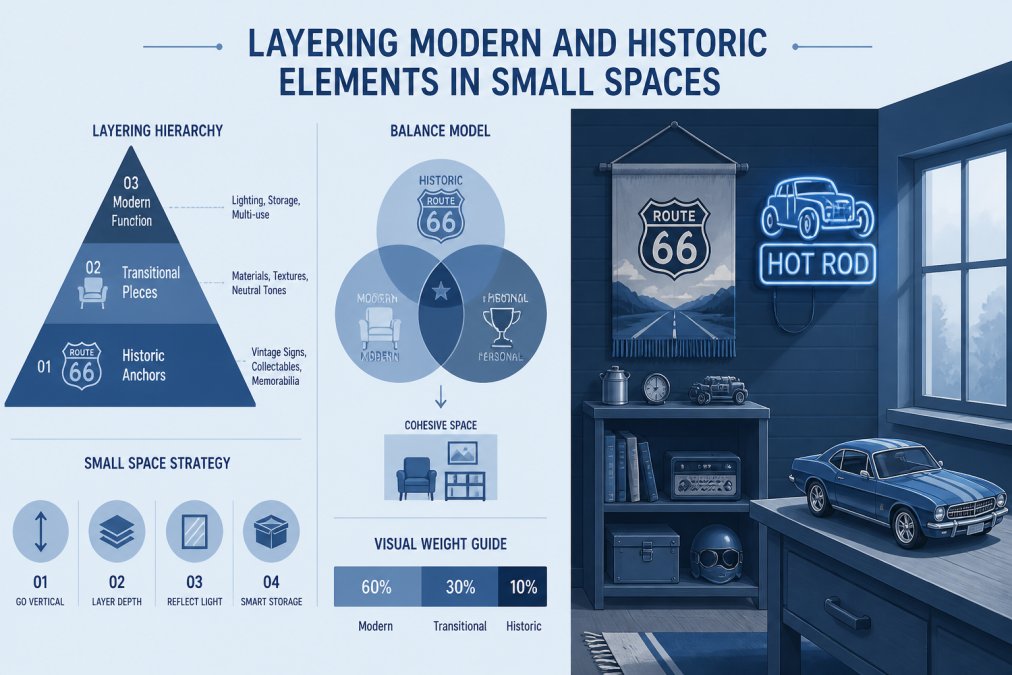
Most vintage Americana guides assume a heritage house with wide rooms and high ceilings. In a modern apartment or compact unit, the same pieces have to work harder. Layering modern and historic elements in a small room comes down to three moves: one historic focal point, one modern counterweight, and deliberate use of vertical space. Maximalist layering works in large rooms; in small ones it reads as clutter.
The Small-Space Rule: One Era Per Wall
In a large room you can mix three or four eras across a single sightline. In a small room, that reads as noise. A workable pattern is one era per wall:
- Wall A, the historic anchor. A single large piece (a vintage neon sign, a framed Route 66 poster, a salvaged timber shelf) carries the wall on its own.
- Wall B, the modern counterweight. Clean-lined storage, a plain linen curtain, or a simple contemporary lamp. This is what stops the room feeling like a museum.
- Wall C, the working wall. Books, records, everyday objects. Keep this neutral so the eye rests.
- Wall D, negative space, or a mirror to borrow light.
Vertical Layering Beats Horizontal Layering
Floor space can be a scarce resource in a small home. Consider pushing the collection upward instead:

- Mount neon and signage at eye level or slightly above, never at floor level. A sign on the floor competes with furniture; a sign on the wall floats above it.
- Use narrow, wall-mounted shelves rather than freestanding bookcases. A 20cm-deep shelf holds smalls, tins, and models without stealing floor area.
- Hang textiles, a quilt, a pennant, a woven blanket, as wall art rather than draping them over furniture. This frees surfaces and adds texture at height.
- Stack vertically, not horizontally. A column of three small crates reads as one object; three crates spread across the floor read as three obstacles.
The Modern Counterweight: What to Buy New
Small spaces need a few new, quiet pieces to stop the vintage feeling like a theme park. The modern counterweight is usually:
- Lighting, a simple contemporary floor or table lamp with a warm globe. Vintage neon is a feature, not a light source for reading.
- Storage, plain, closed, and tall. Modern storage hides the clutter that vintage display creates.
- One large soft furnishing, a plain rug or curtain in a warm neutral. This is the 60% base of the palette in physical form.
Budget-Friendly Sourcing Beyond Thrift Stores
- Rural clearing sales and farm auctions
- Estate liquidation listings
- Local historical society fundraisers
- Trade-in stock from restoration workshops
- Online estate auction platforms, where regional lots often sell below city market prices because the buyer pool is smaller
- Swap meets and car club events, which frequently carry period signage, tools, and automobilia that never reach a retail floor
Maintaining and Restoring Antique Americana for the Long Term
A practical maintenance routine:
- Dust with a dry, soft brush before any wet cleaning.
- Test any product on a hidden area first, every time.
- Control humidity. Fluctuation damages timber, textiles, and metal more than steady conditions.
- Keep pieces out of direct sun. UV fades fabric and cracks painted surfaces.
- Record condition with dated photos so you can spot slow changes.
For a broader reference on material care, Canadian Conservation Institute preservation guidance sets out condition and handling standards used by museums worldwide.
Frequently Asked Questions
What are the key elements of vintage Americana decor for 2026?
The 2026 look blends warm woods with visible patina, vintage glassware, handwoven textiles and braided rugs, plus curated collections of Route 66 and classic car memorabilia. Earthy palettes built on terracotta, moss green and burnt orange replace the brighter reds of earlier revivals. Deep navy and moody tones anchor smaller rooms. The overall effect is lived-in and heirloom quality rather than pristine, which is why authentic craftsmanship and authentic vintage americana collectibles matter more than volume.
How do I mix vintage Americana pieces with modern interior design?
Pick one or two vintage Americana decor focal points and let everything else stay quiet. A vintage neon sign or a Route 66 wall hanging works well against plain walls, simple furniture and warm neutrals. Keep the palette consistent: if you choose earthy palettes, avoid introducing cool greys. Layering modern and historic elements succeeds when the vintage pieces look intentional, not scattered. Group small items like vintage glassware or classic car models on a single display pedestal rather than spreading them across every surface.
How can I tell authentic vintage Americana collectibles from reproductions?
Start with construction details. Genuine pieces show uneven patina, wear in logical places and hardware that matches the era. Reproductions often have uniform finishes, machine-perfect edges and modern screws or adhesives. Check for maker's marks, weight and material feel. For textiles, look at stitching and fabric weave. When in doubt, ask the seller for provenance and compare against reference photos. Buying from a curated selection with clear descriptions reduces the risk compared with anonymous marketplace listings.
Are vintage Americana trends sustainable for long-term home styling?
Yes, and that is part of their appeal. Reusing existing furniture, glassware and textiles avoids the carbon footprint of new manufacturing, and pieces with heirloom quality hold their value better than trend-driven buys. Thrifted furniture and architectural salvage keep materials in circulation. The trade-off is that sourcing takes patience. Build slowly, choose items you will still want in ten years, and treat restoration as part of the process rather than a flaw.