
Last Updated: October 31, 2026
Quick Summary
Vintage hood ornaments work as home decor because they were designed as sculpture, moving easily from garage shelves to mantelpieces, bar tops and study desks. Group three to five pieces per shelf by era or finish, mount each on a custom base, and clean chrome gently to protect the plating.
- Art Deco ornaments from the 1930s suit period interiors, while 1940s and 1950s chrome jet-age forms fit bars and dens.
- Most vintage bonnet mascots weigh roughly 150 g to 600 g and are top-heavy, so stability matters more than strength.
- Aim for a base footprint at least 1.5 times the ornament's base width so it cannot tip.
- Never drill into an original ornament base; always adapt the mount instead to protect its value.
- Keep three to five pieces per shelf and group by era or finish, never both at once.
Table of Contents
- Why Vintage Car Hood Ornaments Work as Home Decor
- Classic Car Hood Ornament Designs That Define the Look
- Bird and Animal Bonnet Mascots to Collect
- How to Mount Hood Ornaments on a Shelf Safely
- Best Practices for Cleaning Vintage Chrome
- Authenticity, Reproduction and Condition Checks
- Styling by Room, Colour and Era
- Shop the Lost America Classic Collection
- Frequently Asked Questions
Why Vintage Car Hood Ornaments Work as Home Decor
A vintage car hood ornament carries genuine history into a room without demanding a restoration project.
The best pieces work as decor because they were designed as art. If you're wondering whether to collect, see whether vintage automotive memorabilia is a good investment.
Below, you'll find guidance on which designs to look for, how to mount them safely, how to clean them without damaging the finish, and how to spot a reproduction.
Classic Car Hood Ornament Designs That Define the Look
Classic car hood ornament design splits into two eras. The 1930s gave us flowing Art Deco forms built for elegance; the 1940s and 1950s swapped curves for speed, chrome and jet-age optimism. Most collectors end up drawn to one era more than the other, and that preference should guide every purchase.
Art Deco Styling and Motifs of the 1930s
Art Deco hood ornaments from the 1930s are the most sculptural of the lot. Designers borrowed from architecture and aviation, using stepped forms, swept wings and simplified figures that suggested motion even when parked.
For a living room or hallway, this era suits period interiors best: flowing lines sit naturally against timber furniture, muted paint colours and warm lighting. Look for clean, unbroken silhouettes; heavy pitting on a 1930s casting is common and hard to reverse, so condition matters more here than almost anywhere else.
1940s and 1950s Chrome and Jet-Age Forms
The post-war years pushed hood ornaments toward speed and flight. Chrome became the dominant finish, and designers leaned on rocket shapes, swept-back wings and stylised aircraft.
Chrome from this period is durable but not indestructible. Plating can flake at sharp edges, and once moisture gets under it, the base metal corrodes. A 1950s piece with intact plating and a solid mounting thread is worth holding onto.
Bird and Animal Bonnet Mascots to Collect
Bird and animal mascots are the most collected category of bonnet mascot: instantly recognisable and photogenic on a shelf.
When choosing an animal figure for decor, think about scale and silhouette rather than rarity.
A common mistake is buying a bird mascot with a repaired wing or re-soldered base and expecting it to hold value. Repairs are acceptable for display but should be reflected in the asking price.
How to Mount Hood Ornaments on a Shelf Safely
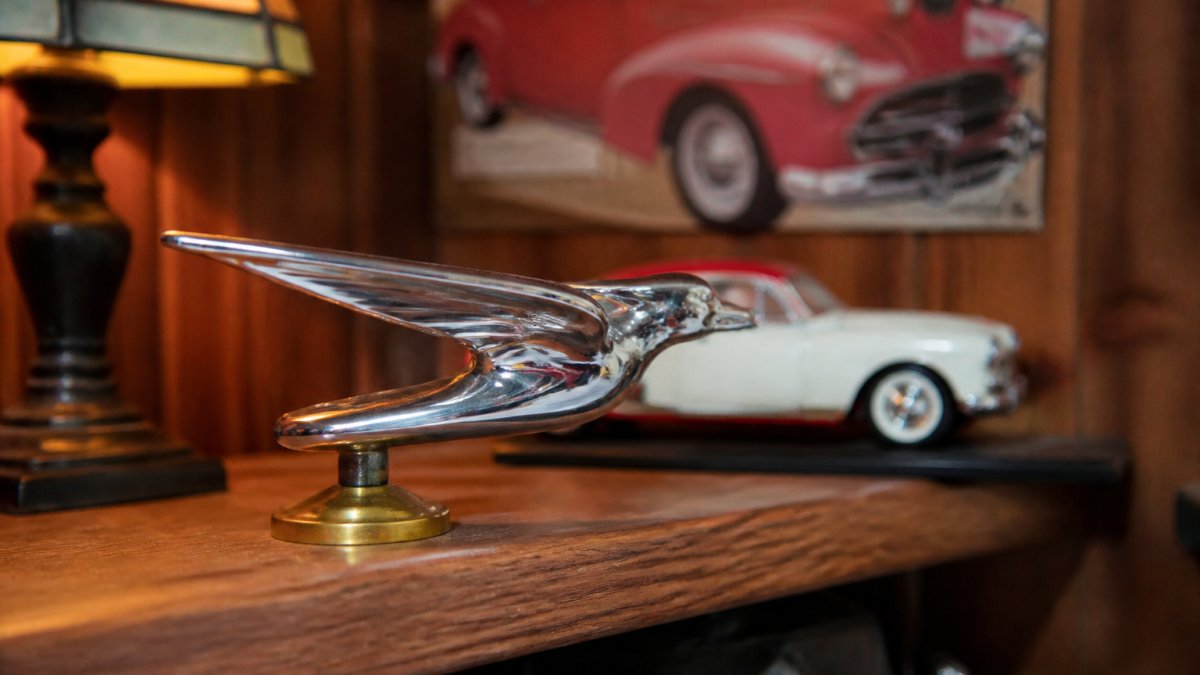
Safe mounting comes down to four things: a stable base, the right fixing for the ornament's foot, a shelf that can take the load, and protection for both metal and furniture. Most vintage bonnet mascots weigh roughly 150 g to 600 g, but they're top-heavy and easy to knock over, so the goal is stability rather than strength. A small custom base is the cleanest solution and keeps the original mounting point untouched. For more display and mounting ideas, see this guide to displaying classic cars.
Start by identifying the foot type. There are three common patterns:
- Threaded stud: a short bolt cast into or welded to the base, usually with a coarse thread. These are the easiest to mount and the most common on 1940s and 1950s chrome pieces.
- Flat foot: a machined or cast flat underside, often with a locating pin. These need a wider base and a removable adhesive.
- Irregular casting: an open or hollow base, common on 1930s alloy figures. These need a shaped cradle rather than a drilled hole.
Here is the method we recommend:
- Measure the ornament's base and note the foot type, stud diameter and thread pitch if there is one.
- Choose a base material: a turned timber block (oak or blackwood), a small acrylic plinth or a brass plate. Aim for a footprint at least 1.5 times the ornament's base width so it cannot tip.
- For threaded studs, drill a matching hole and seat the stud with a drop of clear silicone. Avoid epoxy on anything you might sell later; silicone releases with gentle pressure and leaves no residue.
- For flat-footed pieces, use removable museum putty or a thin pad of closed-cell foam to protect metal and shelf. Never use double-sided tape on plated surfaces; it lifts flaking chrome.
- For irregular castings, line a shallow recess with felt or EVA foam and let the ornament sit in the cradle under its own weight. Add a small foam wedge at the back if it leans.
- Test the fit by nudging the piece gently. If it rocks, the base needs a wider footprint or a second contact point.
- Keep ornaments back from shelf edges and walkways, and use a cabinet with a glass door if you have young children or pets.
Never hang an ornament by its mounting stud alone; the stud is designed for a car bonnet, not repeated lateral loads.
Weight and shelf limits: a standard floating timber shelf on two brackets will comfortably hold several kilograms, but check the fixings rather than guessing. Plasterboard anchors vary widely; a single ornament plus base is usually well within limits, but a group of five heavy cast pieces on one shelf is not. Spread weight across brackets and keep the heaviest pieces nearest the supports.
Best Practices for Cleaning Vintage Chrome
Cleaning vintage chrome is mostly about restraint. The plating on older ornaments is thin, and aggressive polishing removes the very layer that gives the piece its shine.
1948 Chevrolet Fleetmaster Woody 1:18 →
Work through these steps:
- Dust first with a soft brush or microfibre cloth. Dry dusting removes most of the problem.
- Wash with lukewarm water and a drop of mild dish detergent, using a soft cloth only.
- For light tarnish, use a dedicated chrome polish sparingly and buff with a clean cloth. Readers dealing with tarnished metal collectibles can also learn the best way to clean tarnished brass.
Watch out: the biggest mistake is polishing a piece with flaking plating. The cloth catches the loose edges and lifts more of the finish. If the plating is already lifting, clean around it and leave the flaked area alone.
Authenticity, Reproduction and Condition Checks
Reproduction ornaments are everywhere, and some are very good. The difference usually shows up in casting quality, weight and finish.
Run through this checklist before you buy:
- Check the weight in your hand. Originals feel denser than most cast reproductions.
- Inspect the detail under a magnifier. Original castings show fine tool marks; reproductions look smooth and soft.
- Look at the base and mounting point for wear patterns consistent with real use.
Condition grading matters as much as authenticity for decor buyers. A piece with minor surface wear displays beautifully and costs far less than a mint example. If you're buying to display rather than to invest, honest wear is not a problem.
Styling by Room, Colour and Era
Styling is where most collections either come together or fall apart.
Scale is the second rule.
Room by room, here is how we would approach it:
| Room | Best placement | Finish to lean on | Era that suits | Scale note |
|---|---|---|---|---|
| Home bar | Back of the bar top, under lighting | Chrome | 1950s jet-age forms | One hero piece, 15-20 cm tall |
| Garage or workshop | Wall shelf above the bench | Silver-tone alloy | 1930s Art Deco | Group of three, mixed heights |
| Study or den | Bookshelf, mid-height | Mixed with one black finish | 1940s chrome | Two or three pieces, spaced |
| Living room | Mantel or sideboard | Chrome | Bird and animal mascots | Single large piece or a pair |
| Hallway | Narrow console | Silver-tone | Compact animal figures | Low and wide, away from elbows |
Colour coordination: chrome and silver-tone pieces lift dark timber and navy walls. A single black finish ornament anchors a lighter shelf.
Lighting: a small warm LED picture light or shelf spotlight at 2700-3000 K brings out chrome without the harsh reflections of a cool white globe.
Avoid overcrowding: three to five pieces per shelf is plenty, with breathing room between them. For more ideas, read about avoiding clutter with vintage home decor.
Shop the Lost America Classic Collection
Our curated collection includes pieces for this kind of display. The 1948 Chevrolet Fleetmaster Woody 1:18 ($75.00) is a diecast model, and the Vintage Car Stein ($50.00) brings a nostalgic touch to a home bar. For wall space, the Mopar Wall Hanging, Ford Wall Hanging, Shelby Wall Hanging, Route 66 Wall Hanging and Used Cars Wall Hanging are each $50.00 and give a garage or den a finished look around your ornament display.
Frequently Asked Questions
Are vintage hood ornaments valuable as home decor?
They can be, and value depends on rarity, original condition and the maker. Genuine chrome bonnet mascots from the 1930s to 1950s hold their appeal because supply is fixed and collectors compete for clean examples. Reproduction pieces cost far less and suit styling jobs where you want the look without the insurance worry. Before buying, check for pitting, re-chroming and missing bases, because those faults cut value sharply. Treat any ornament as a decor purchase first and an investment second.
How do I safely mount a vintage hood ornament for display?
Skip drilling into the ornament itself. Instead, fix a small timber or acrylic plinth to the shelf with removable adhesive or a hidden screw, then seat the ornament base on the plinth using a museum-grade putty or a custom-cut cradle. Keep the piece back from shelf edges and away from walkways, and avoid high-traffic shelves where a knock is likely. For heavier cast metal mascots, use a bracket that grips the base rather than the sculpted figure, so the chrome stays untouched.
What are the most iconic hood ornament designs from the 1930s?
The 1930s produced the boldest Art Deco mascots: stylised archers, leaping animals, winged figures and geometric speed lines meant to suggest motion. Chrome and polished alloy figures with swept-back forms are the signature of the era. Many were designed as standalone sculptures rather than brand badges, which is why they still read as art today. When collecting from this period, expect thinner castings and more wear, so inspect the base and mounting thread closely before you commit.
How do I clean and preserve antique chrome hood ornaments?
Use the least aggressive method first. Dust with a soft microfibre cloth, then wipe with warm water and a drop of mild dish soap. Rinse and dry immediately so water does not sit in seams. For light tarnish, a non-abrasive chrome polish applied sparingly and buffed with a clean cloth is enough. Avoid steel wool, abrasive pads and acidic cleaners, which dull the finish and remove what is left of original plating. Keep displayed pieces out of direct sun and humid rooms to slow corrosion.
Can I use reproduction hood ornaments for interior styling?
Yes, and reproductions make sense for shelves in busy rooms, home bars and garages where an original could be knocked or damaged. Modern castings often hold a sharper finish and cost a fraction of an antique, so you can group several for a stronger display. Label them honestly if you resell, and keep originals for protected cabinets. Mixing one genuine piece among reproductions is a common approach: the original becomes the focal point and the rest carry the theme.
Building a display that feels collected rather than cluttered takes a bit of planning, and that's the part most people underestimate. If you'd rather start with pieces that already work together, we can help. Browse the Lost America Cool Classic Collectables range for curated vintage-inspired decor, classic vehicle models and nostalgic collectibles, and start with a single shelf. Get started with Lost America Cool Classic Collectables and build a display that earns a second look.
