
Last Updated: October 25, 2026
Quick Summary
Most vintage automotive memorabilia is not an investment at all, but a passion purchase you enjoy owning. A smaller group, bought carefully and held for years, can hold or grow its value, though ownership and selling costs eat into any gain.
- Memorabilia has no registry or standard valuation, so value rests on rarity, condition, authenticity and buyer demand.
- Build an evidence file of at least three to five completed comparable sales before you commit to any piece.
- Check materials, manufacturing marks and wear patterns to spot reproductions flooding the market.
- A hypothetical $1,000 piece sold for $1,400 five years later can net a $100 loss after about $500 in costs.
- Plan your exit before you buy and assume the sale will take longer and cost more than expected.
Table of Contents
- Is Vintage Automotive Memorabilia a Good Investment? The Honest Answer
- Memorabilia Versus Collectible Cars: Two Very Different Assets
- How to Value Vintage Car Collectibles Before You Buy
- How to Identify Authentic Car Memorabilia and Avoid Counterfeits
- Collectible Diecast Car Models: Entry-Level Investment or Passion Purchase?
- Storing and Displaying Automotive Memorabilia Without Damaging Value
- Returns After Ownership Costs: What the Numbers Really Look Like
- Building Your First Nostalgia Collection With Lost America Cool Classic Collectables
- Frequently Asked Questions
Is Vintage Automotive Memorabilia a Good Investment? The Honest Answer
Short answer: it depends on what you buy and what you expect.
Vintage automotive memorabilia is a catch-all term for the objects that grew up around cars: pedal cars, service station signage, gas pumps, promotional models, dealer displays and diecast cars.
Below, we break down where the money actually sits in this market, how to value a piece before you commit, and how to spot the fakes that flood it.
Memorabilia Versus Collectible Cars: Two Very Different Assets
The biggest mistake we see is treating a shelf of collectibles like a car in a garage. They are not the same asset class.
A collectible car carries a title, chassis number, service history and an established auction market.
That means memorabilia suits smaller budgets: you can enter the market for the price of a diecast model rather than a full restoration.
If you are weighing categories against each other, is buying vintage pedal cars worth it in 2026? is a useful next read, because pedal cars sit right on the line between toy, decor and collectible.
How to Value Vintage Car Collectibles Before You Buy
Valuation starts with comparables, not enthusiasm. Before you pay for any piece, find what similar items in similar condition have actually sold for. Asking prices are fiction; completed sales are the only honest signal.
The Four Factors That Set Market Value
Four things drive the price of almost every piece of automotive memorabilia:
- Rarity: How few survive, and how few come to market in a year. A limited promotional run beats a mass-produced item every time.
- Condition: Original paint, intact glass, working mechanisms and no rust matter enormously. A sympathetic patina is often worth more than a clumsy repaint.
- Provenance: Where the piece came from. A sign from a named, long-closed service station carries a story that a generic one does not.
A common mistake is valuing an item by size or visual drama. A large, striking piece in poor condition is often worth less than a small, rare one in original order. Judge the piece, not the impression it makes.
How Valuation Changes by Memorabilia Category
The four factors do not carry equal weight across every category. Treat each on its own terms:
- Service station signage and enamel signs: Maker, era and originality of the enamel dominate. A sign from a recognised manufacturer with intact original enamel and documented station provenance sits at the top; a repainted or reproduction sign sits near the bottom. The price gap between mint original and restored is wide.
- Petrol pumps and garage equipment: Completeness and working order matter more than cosmetics. A pump with its original globe, hose and mechanism is a different asset from a cosmetically restored shell. Buyers pay for originality of mechanism, not just paint.
- Promotional and dealer models: Scale, maker, limited-run status and box condition drive value. A limited promotional run in its original packaging is a different proposition from an open, played-with example of the same casting.
Using Documented Sale Evidence
A single asking price tells you nothing. Build an evidence file before you commit:
- Collect at least three to five completed sale results for comparable pieces in comparable condition, from auction houses, specialist dealers and established online marketplaces.
- Note the date of each sale. Memorabilia markets move in cycles, and a sale from five years ago is weak evidence for today's price.
- Record the condition grade and any restoration disclosed at the time of sale. A price without a condition note is not a comparable.
If you cannot find three credible comparables, you are guessing. Either walk away or price the uncertainty in and treat the purchase as a passion buy rather than an investment.
How to Identify Authentic Car Memorabilia and Avoid Counterfeits
Authenticity is where money is most easily lost. Reproductions are everywhere, and many are good enough to fool a casual buyer. The fix is process, not instinct.
Work through these checks before you commit:
- Compare materials to the period. Older metal, glass and enamel age in specific ways. Modern reproductions often look too clean or use materials that did not exist when the original was made.
- Look for period manufacturing marks. Stamps, maker's marks and fasteners should match the era.
- Check the wear pattern. Genuine age shows uneven fading, patina and wear where a piece was actually handled. Uniform artificial ageing is a red flag.
For a deeper walkthrough, our guide on how to identify authentic vintage Americana covers the tells in more detail. It is worth reading before you spend on anything you cannot inspect in person.
Collectible Diecast Car Models: Entry-Level Investment or Passion Purchase?
Diecast models are the most accessible entry point into the category, and the most misunderstood. A 1:18 scale model is a display object first. Some limited runs appreciate, but the vast majority are bought to be enjoyed, not sold at a profit.
That is not a reason to avoid them, just a reason to be honest about why you are buying. Our 1948 Chevrolet Fleetmaster Woody 1:18 at $75 shows what the entry level looks like: a detailed, display-ready piece that adds character to a desk or shelf without a collector's budget.

Where diecast models earn their keep is as the foundation of a collection: they let you learn the market, makers and condition standards at low cost before you move up to larger pieces. For a fuller picture, our guide on authentic classic car models sets out what to check.
Harley Davidson Dual Gas Pump →
Storing and Displaying Automotive Memorabilia Without Damaging Value
How you keep a piece matters as much as what you paid.
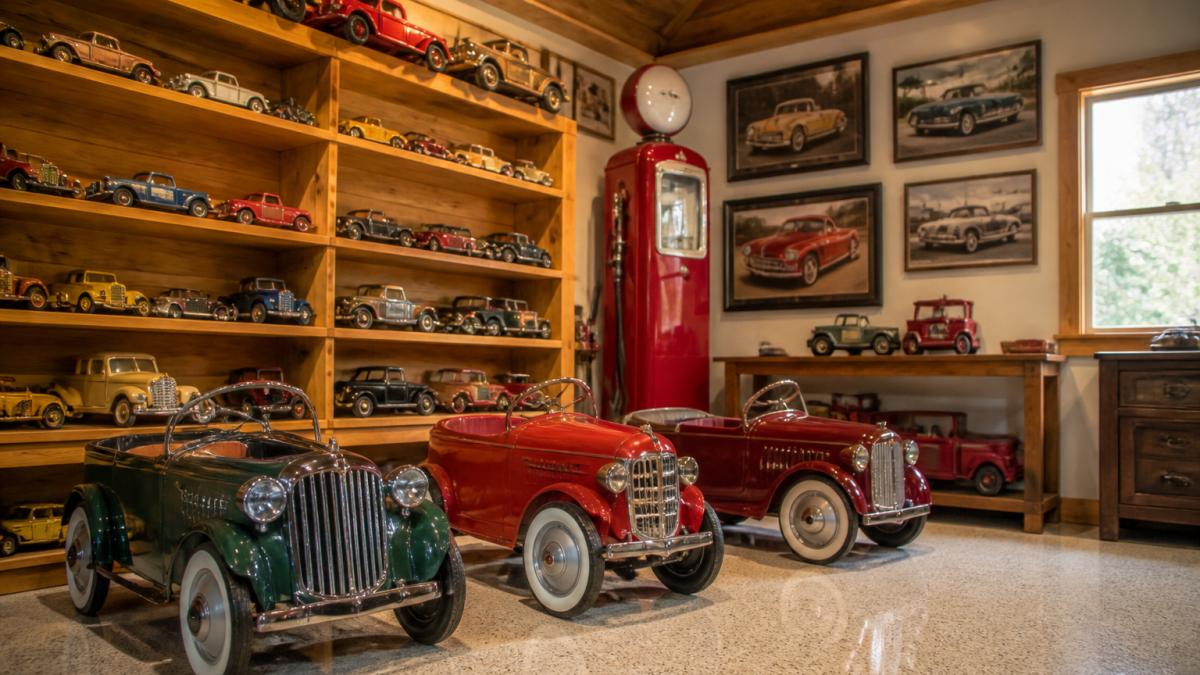
Keep pieces out of direct sun, away from damp and off unstable surfaces. Clean painted or printed surfaces gently, testing a hidden area first; our guide on how to clean vintage metal signs without ruining them is a sensible reference before you touch a cloth to anything valuable.
Watch out: aggressive cleaning is one of the fastest ways to turn a collectible into a damaged item. When in doubt, do less.
Returns After Ownership Costs: What the Numbers Really Look Like
Here is the part most buying guides skip. The return on memorabilia is not the sale price minus the purchase price. It is the sale price minus everything you spent to own, store, insure and eventually sell the piece.
Those costs add up: storage, insurance, restoration, display materials and selling fees all eat into any gain. A piece that rises modestly over several years can return nothing once they are counted.
| Cost Category | What It Covers | Effect on Return |
|---|---|---|
| Purchase price | What you paid to acquire the piece | Sets your cost base |
| Ownership costs | Storage, insurance, display materials | Reduces net gain over time |
| Restoration | Repairs, cleaning, sympathetic conservation | Can add value or destroy it |
| Selling costs | Fees, transport, time to find a buyer | Cuts into the final figure |
A Worked Example of Net Return
Consider a hypothetical piece bought for $1,000 and sold five years later for $1,400. The headline gain is $400, or 40% before costs. Now subtract the costs of owning it:
- Insurance at roughly 1% of value per year: about $50 over five years.
- Storage and display materials: $150 over five years.
- Conservation or minor restoration: $100.
Total costs: about $500. The net result is a $100 loss on a piece that appeared to gain 40%. This is routine once realistic costs are applied. The lesson is not that memorabilia never appreciates, but that headline appreciation has to clear a meaningful cost hurdle before it becomes a real return.
How Memorabilia Compares With Other Assets
Collectors often ask how memorabilia stacks up against classic cars, shares, bonds or other collectibles. The comparison is imperfect, because memorabilia has no single index and no standardised valuation. With that caveat:
- Classic cars have established auction records and specialist indices, but carry far higher ownership costs, registration, maintenance, insurance and storage, and are slower to sell at the top end.
- Shares and bonds are liquid, divisible and cheap to trade, but offer no enjoyment value and no connection to the subject matter.
- Other collectibles such as art, watches and wine have their own indices and auction infrastructure, but the same liquidity and authentication risks apply.
Memorabilia's distinguishing feature is that its return is partly non-financial: the pleasure of ownership, the character it brings to a space and the knowledge gained while collecting. That does not make it a better investment, just a different kind of purchase, and it should be judged on those terms.
Fees, Liquidity and Time to Sell
Selling costs and time to sell vary sharply by channel:
- Auction houses typically charge a seller's commission plus listing and photography fees, and may also charge a buyer's premium that affects the final price achieved. They offer the widest buyer pool for rare pieces but take weeks to months to settle.
- Specialist dealers may buy outright at a discount to retail or sell on consignment for a commission. They offer speed and certainty at the cost of margin.
- Online marketplaces have lower fees but a thinner buyer pool for specialist items, and the risk of a sale falling through is higher.
Plan your exit before you buy, and assume the sale will take longer and cost more than you expect.
Building Your First Nostalgia Collection With Lost America Cool Classic Collectables
Start small, buy what you love, and let knowledge guide the spend. That is how most good collections begin.
Our curated range is built for exactly this. Pieces like the Vintage Fire Pedal Car at $450 or the Vintage Pedal Car at $300 give you a substantial display piece without a car-sized outlay. For a statement centrepiece, the Harley Davidson Dual Gas Pump at $2,000 anchors a garage or den. If you are ready to browse, our premium classic memorabilia for home display collection is the place to start.


Buy the piece you want to live with. Store it well, learn its history, and treat any appreciation as a welcome extra rather than the reason you bought it.
The real challenge with vintage automotive memorabilia is not finding pieces you like. It is buying well enough that you never regret the spend.
Frequently Asked Questions
Is vintage automotive memorabilia a good investment?
It depends on what you buy and how long you hold. Rare, authentic pieces with documented provenance can appreciate, but most memorabilia sells for enjoyment rather than financial return. Factor in purchase price, restoration or cleaning, insurance and selling fees before you count a profit. Treat vintage automotive memorabilia as a passion asset first: if it also gains value, that is a bonus rather than a guarantee.
How do I value vintage car collectibles before making an offer?
Start with completed sales, not asking prices. Look at what comparable items actually sold for, then adjust for condition, originality, rarity and provenance. A piece with original packaging, a known history or a limited production run commands more than an identical item without those details. When you value vintage car collectibles, deduct any restoration costs and selling fees so you are comparing net figures, not headline prices.
How can you tell whether automotive memorabilia is authentic?
Check construction details first: period-correct materials, fasteners, paint finishes and manufacturer markings. Reproductions often use modern plastics, uniform finishes or incorrect logos. Ask for provenance such as receipts, auction records or photographs of the item in its original setting. If you are unsure how to identify authentic car memorabilia, buy from a curated seller who can answer questions about where a piece came from rather than an anonymous marketplace listing.
Do collectible diecast car models increase in value?
Some do, most do not. Limited editions, discontinued castings and models kept in original packaging with no fading or paint rash tend to hold value best. Common, mass-produced models usually sell for close to their original retail price. Collectible diecast car models work well as a low-cost entry point, but expect modest returns and buy the castings you actually want to display.
How should I store and display automotive memorabilia?
Keep pieces out of direct sunlight, which fades paint and decals, and away from damp. Garages are popular display spaces but humidity damages metal, paper and cardboard, so use sealed cabinets or a dehumidifier. Mount shelving securely and keep heavy items like a gas pump at floor level. Storing and displaying automotive memorabilia well protects resale value and stops a collection from looking cluttered.
