
Last Updated: October 29, 2026
Quick Summary
To avoid clutter with vintage home decor, audit what you own, scoring each piece on use, condition, sentimental value and visual contribution. Then pick one focal point, edit around it, and rotate a collection so only part of it is on display.
- Score each piece out of five on use, condition, sentimental value and visual contribution.
- A total score of 16 or above is a clear keep; 8 or below is a clear candidate to let go.
- Clear at least half of every surface, starting with the coffee table, sideboard or mantel.
- Rotate displays every three to four months and store the rest in labelled boxes.
- Adopt a one-in-one-out rule to keep the room from filling up again.
Table of Contents
- Why Vintage Décor Turns Cluttered and How to Stop It
- Step 1: Audit What You Already Own
- Step 2: Choose a Focal Point and Edit Around It
- Step 3: Balance Scale, Proportion and Colour When Mixing Vintage and Modern Furniture
- Step 4: Display Collectibles Without Crowding the Room
- Small Spaces, Renters and Caring for Your Pieces
- Keeping Your Vintage Room Tidy: Your Next Steps
- Frequently Asked Questions
Why Vintage Décor Turns Cluttered and How to Stop It
Vintage home decor is one of the most rewarding ways to give a room character.
The good news is that clutter is not a vintage problem. For broader decluttering tips, see general guide to avoiding cluttered decor. For retro-specific fixes, read tips for avoiding cluttered retro decor.
Here is what usually causes the problem:
- Buying by impulse. A charming find at a market seems like a bargain until there is nowhere to put it.
- No clear focus. When every surface has something on it, the eye has nowhere to rest.
- Mixing too many eras and styles without a shared colour or material thread.
Use one simple rule to start: if a piece does not earn its place, it moves to storage or goes to a new home.
Step 1: Audit What You Already Own
Before buying anything new, take stock. To judge whether your existing pieces are high quality vintage style decor, check the buyer's guide. Clear a shelf or table and gather everything you have in one spot.
Most vintage collectors do not struggle to spot clutter. They struggle to decide what to do about it. A vague feeling that a room is too full is not a plan.
Score each piece on four criteria
For every item, give a quick score out of five on each of the following. You do not need to be precise, a gut score is fine. The point is to force a comparison rather than judge each piece in isolation.
- Use. How often does it actually get used or worn? A clock you check daily scores higher than a decorative tin you have never opened.
- Condition. Is it stable, or does it need repair you keep postponing? Pieces that are fragile, chipped or missing parts tend to become clutter because they cannot be handled or displayed safely.
- Sentimental value. Does it connect to a person, place or moment you genuinely want to remember? Be honest: inherited does not automatically mean meaningful.
Add the four scores. A total of 16 or above is a clear keep. A total of 8 or below is a clear candidate to let go. The middle band is where most of the difficulty lives, and that is where the next step helps.
Apply the method room by room
Working through the whole house at once is overwhelming. Break it into zones and give each one a single session. A practical order is:
- Living room. Start with surfaces, coffee table, sideboard, mantel. These are the highest-visibility clutter traps. Aim to leave at least half of every surface bare.
- Entryway. This is where clutter accumulates fastest because it is where things get dropped. Keep only what is used on the way in or out. A single bowl for keys and one hook per person is usually enough.
- Bedroom. Focus on bedside tables and dresser tops. Vintage décor in a bedroom works best when it is restful, so favour a few larger pieces over many small ones.
- Kitchen. Vintage kitchenware is charming but bulky. Keep only pieces you cook with or display deliberately, and store the rest rather than leaving it on the bench.
- Hallways and spare rooms. These are the rooms where clutter hides. Be stricter here than anywhere else, because nothing in them is seen often enough to justify keeping.
Handle the borderline pieces
For anything in the middle band, use a temporary holding box rather than deciding on the spot. Label it with the date and put it out of sight. If you have not gone looking for an item in eight weeks, you have your answer. This is far more reliable than trying to talk yourself into or out of keeping something in the moment.
Keep the system running
A one-in-one-out rule keeps things steady once the initial audit is done. For every new item that comes in, one older item leaves.
Watch out: Do not decide everything in one afternoon. Sort into three piles (keep, store, let go) and come back to the "store" pile after a week.
The article gives a simple scoring method for deciding which pieces to keep, using four criteria out of five each.
| Criterion | What to ask | Score guide |
|---|---|---|
| Use | How often is it used or worn? | Out of 5 |
| Condition | Is it stable, or does it need postponed repair? | Out of 5 |
| Sentimental value | Does it connect to a meaningful person, place or moment? | Out of 5 |
| Visual contribution | Would the room look worse without it? | Out of 5 |
| Keep | Total score of 16 or above | Clear keep |
| Let go | Total score of 8 or below | Clear candidate to let go |
Step 2: Choose a Focal Point and Edit Around It
Every well-styled room has a clear focal point. In vintage décor, this is usually a statement piece such as a large mirror, a restored sideboard or a bold vintage lamp.
Here is a simple way to edit around one focal point:
- Pick the single strongest piece in the room.
- Clear the space within a metre of it so it can breathe.
- Remove or relocate anything that sits in its line of sight.
- Add at most two or three supporting items that share its colour or material.
A vintage mirror, for example, works well as a centrepiece. If you are unsure which piece to start with, beginner retro decor ideas can help you choose. Our Vintage Mirror ($90.00) can anchor a wall without much else around it.
Step 3: Balance Scale, Proportion and Colour When Mixing Vintage and Modern Furniture
Many people love the mix of antique and modern pieces. It can look relaxed and personal, but it works best when scale and colour are handled carefully.
Keep these points in mind:
- Match the scale. A tiny retro radio on a huge modern sideboard can look lost. Pair large pieces with large pieces, and small with small.
- Repeat one or two colours across old and new items so the room feels connected.
- Use one material as a thread, such as brass or timber, to tie the pieces together.
A useful test is to stand in the doorway and look at the room. If your eye jumps around without settling, remove one item and look again.
Step 4: Display Collectibles Without Crowding the Room
Collections are the heart of vintage décor, and they are also the most common source of clutter. The goal is to show your favourite pieces without burying them. The difference between a collection and a pile is usually not the number of items, it is whether there is a system deciding which pieces are out, how they are grouped, and where the rest live.
Group by theme, not by accumulation
A collection displayed with intent reads as deliberate. A collection displayed wherever there was a gap reads as clutter. Choose one organising principle per group and stick to it:
- By material. Brass together, timber together, enamel together. This creates visual rhythm and makes mixed eras feel connected.
- By colour. A shelf of blue-and-white ceramics or a wall of warm-toned tins looks curated even when the pieces span decades.
- By function. Kitchenware in the kitchen, clocks in the hallway, textiles in the bedroom. Context does a lot of the editing for you.
Group in odd numbers, three or five items in a cluster look more deliberate than two or four. Vary the height within each group so the eye has somewhere to travel, and leave a bare patch of shelf between groups. Empty space is what makes the pieces you do display look important.
Rotate on a schedule
Rotation is the single most effective way to enjoy a large collection without crowding a room. Keep a small selection out and store the rest.
- Store pieces in labelled boxes by category, with a note of what is inside.
- Swap displays every three to four months, or at the change of season.
- Photograph each rotation so you remember what you have and where it looked best.
This keeps the room feeling fresh and means every piece gets its moment rather than competing for attention all at once.
Use vertical space and wall groups
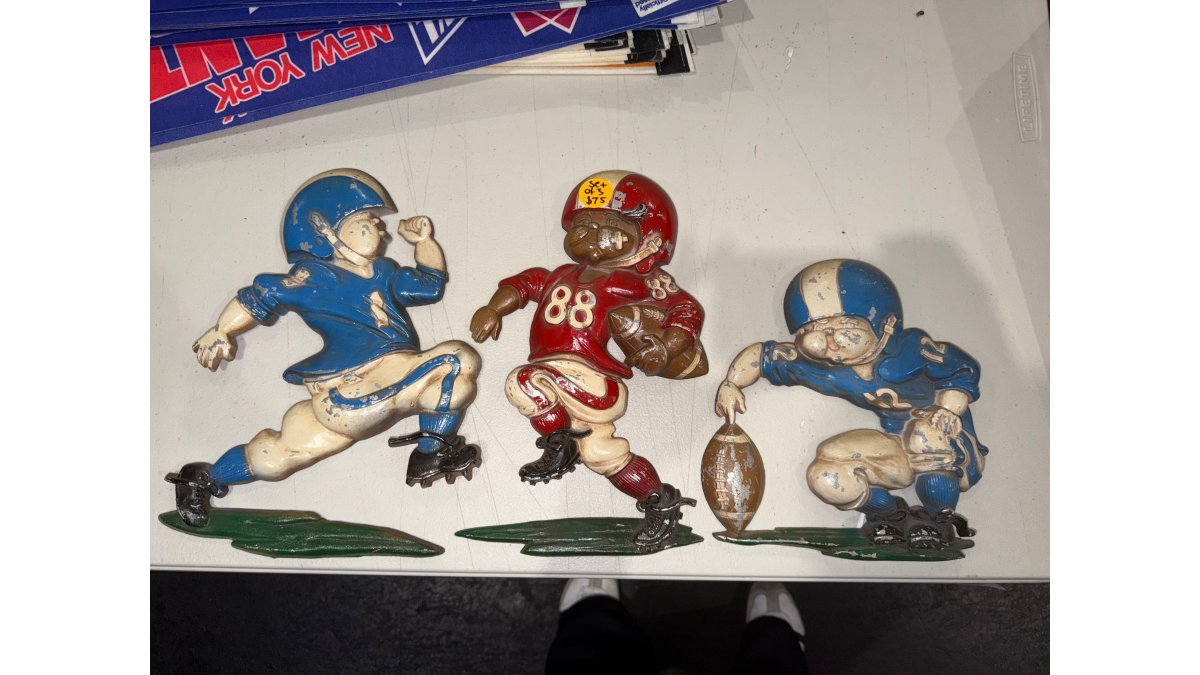
Open wall shelving keeps items off surfaces and draws the eye upward, which is especially valuable in smaller rooms. For a collection of classic signs or clocks, a single wall group of three pieces, such as our Vintage Clocks/Wall Decor ($100.00) or the Vintage Wall Decor Set of 3 ($75.00), can add personality without filling every inch.
Store the rest properly
Storage is part of display, not a failure of it. Pieces that are stored well last longer and are easier to rotate back out.

- Wrap ceramics and glass in acid-free tissue or soft cloth rather than newspaper, which can transfer ink.
- Keep textiles folded flat in a dry, dark place, and avoid plastic bags that trap moisture.
- Store metalware away from damp, and give brass and copper a light wipe before boxing.
Protect what you display
Fragile finishes and strong sunlight are the two biggest threats to a displayed collection. Keep pieces out of direct sun, which fades colours and can crack lacquer and veneer. Use museum putty or a small strip of removable adhesive under items on open shelves, particularly in busy rooms or homes with pets. Dust with a soft cloth rather than a feather duster, which mostly moves dust around.
Small Spaces, Renters and Caring for Your Pieces
Small rooms and rentals need a lighter touch. You may not be able to fix things to walls, and every item takes up more relative space.
Care matters too. Keep pieces dry and out of strong direct sunlight, which can fade colours and crack finishes. Dust regularly with a soft cloth, and check screws and fittings on older furniture each season.
Keeping Your Vintage Room Tidy: Your Next Steps
Start small this week. Pick one shelf or one corner, run through the three-question audit and move anything that does not belong. Then choose a focal point and clear the space around it.
If you are looking for pieces that suit a clean, balanced room, browse the Lost America Cool Classic Collectables range to find a few well-chosen items that earn their place.
Frequently Asked Questions
How do you decorate with vintage items without creating clutter?
Start by choosing one focal point, such as a statement piece or a vintage mirror, and build the rest of the room around it. Limit each surface to a few items and leave open space between them. Before adding anything new, remove one existing item to keep the balance. Clutter usually comes from too many small objects competing for attention, so fewer, better-chosen pieces will always look more deliberate than a crowded display.
How many vintage pieces should you display in one room?
There is no fixed number, but a useful guide is to give each room one or two statement pieces, a small number of accent items and a few smaller collectibles grouped together. If a surface looks busy from the doorway, you have probably passed the point where it feels curated. Rotating pieces through storage every few months keeps a collection fresh without adding more objects to the room.
How can you mix vintage furniture with modern decor?
Pair vintage furniture with modern pieces that share a colour, finish or material. Match the scale of pieces so a large antique does not sit next to a much smaller modern item. Keep the colour palette to three or four main tones across both old and new pieces so the room feels cohesive rather than mismatched.
What vintage items should you declutter from your home?
Start with items that are damaged beyond repair, duplicates, and pieces you no longer enjoy looking at. Use a one-in-one-out rule so that every new piece you bring in replaces one you already own. Keep sentimental items if they matter to you, but store the ones that do not earn a place on display. A simple test is to ask whether each item still adds something to the room or simply takes up space.
